Showing posts with label philosophy. Show all posts

Friday, January 20, 2017

On This Day, My Friends


Today I woke up and looked out the bedroom window onto a beautiful landscape. Frost encrusted every surface, ice formed sculptures on the river bank, smoke puffed cheerily from chimneys, the sky was bright and clear, and everything from the ground to the rooftops glistened like crystal. I smiled.

And, then I remembered.

This beautiful countryside with its quaint villages of red tiled roofs, frost covered hillsides, and lazy river isn't my home. My home sits on the other side of the Atlantic, big and wide, full of lazy rivers, and frosty small towns and hillsides, and humming cities. Smoke curls out of chimney roofs there too. While I write this, the first slice of that country will be waking. They will be looking out bedroom windows too, as they rise to go to work or school or to whatever the day dictates. Home is where most of my friends dwell. Home is where my family makes their lives. Home is a place I only get to see once a year, twice if I'm lucky. Home is the place I cherish above all others. I think about it every single day. I love it and I miss it.

But, it is dying. In these few hours it's breathing its last rasping breaths. I won't be there when it closes its eyes and leaves this earth. I will probably never see it again. Home will be gone.

I, like so many of you, am grieving. The coming inauguration is the worst possible result I could have imagined of that horrible election cycle. There are still days I can't believe it happened. The thought of what it means still catches the breath in my chest. But, this is where we are now, my friends, and it is time to move forward.

To my fellow grieving Americans, now is the time to see what we're made of. Now is the time to live up to the hype. We had our three months to grieve and cope. Now we must pick ourselves up and face this day, face it in a way that our forbearers would be proud of. They created a government and system that is designed to resist tyranny. But, it cannot do that if we, The People, embrace tyranny or stay impassive and silent. Patriots aren't people who go to Fourth of July parades, or buy bumper stickers, repost impassioned memes, or wear patches and pins. Patriots get up and participate. They call their representatives over and over and over. Patriots march. Patriots give their money or- if they don't have money- their time to organizations that defend the rights and ideals of their nation that are under threat. Patriots look past differences in their fellows and they unite against their common foe. They discuss. They sacrifice and they give up their petty wants for the sake of others, their contemporaries and those yet to be born. Patriots are vigilant. Patriots pursue the truth. Patriots resist. Please, my fellow Americans who do not rise in celebration on this day, be patriots. The future depends on it. More than we know.

To those Americans who rise on this day with elation, go ahead. That's your right. I know there is nothing I can say that will change your minds. That is ok. But, I'm sorry for you. I truly am, and I do not say it to be patronizing. I was very angry with you for a long time. Sometimes I still get angry at you. But, my faith doesn't allow me to stay in that place so on this day, I've decided to set that anger down. Pity fills that space that anger left behind. I know where you're coming from. I know you. I understand your fears and anger. I'm from Akron, Ohio. I know what it's like to search in vain for work, to see the rot, to feel hopeless and forgotten. I know what it's like to be told your heritage and culture is not something to be proud of. I'm in agreement that a lot of this is caused by the decisions of our past leaders. Yes, the Left has done a lot of damage. I get it, I really do. I respect the fact that these are real problems. However, I in no way agree with your solution. I feel sorry for you because you don't yet understand what today means or worse, you do and refuse to admit it. We've all been in that headspace at one time or another and it isn't a good place to be. My hope is that you will be willing to step out of it and be a part of the movement to clean up the mess. We'd be happy to have you. Until then, know this: any attempt on your part to persecute or strip the rights of innocent citizens of this nation will be met with strong resistance. That behavior will not be tolerated. We will not tolerate it in the elected officials and we will not tolerate it from you. We will stand in your way. And, as much as it breaks my heart to say this, it will not matter if you're our friends or our family members. We will stand against you. This is going to hurt all of us, and I'm truly, truly sorry.

To all my international friends, those who are scared and nervous about today too, please lend a hand. Trust me, I have not been proud to be an American for several months and I get why it's so easy to blanket the entire country is far right fools. However, if you followed the US Election at all you know by now that this result is not the will of the people. This man did not win the popular vote. His victory, is the result of many factors- foreign actions and flawed internal systems. Please keep that in mind when things get scarier. There are many Americans on your side. They are going to be sacrificing a lot to stop this darkness from destroying our country and they will need your encouragement, words will do. The world is at a tipping point, and this day is a death knell. It could easily lead to the dark takeover of your nation too. The rumblings of coming thunder can be heard in the words of Farage, La Pen, and Petry just to name a few. The darkness is at every gate. So, please, please don't turn your backs. Don't mock and throw up your hands and resign us to our fate. We're in this together and we're all going to need to stick together.

Today is not a normal day. Tomorrow won't be normal either, and nor will the day after that and the day after that. In my heart I know no day will ever be normal again. But, I will not cry anymore. After I turned from my bedroom window, I did what I promised myself I would do on this day. I started my resistance. I purchased a subscription to The Washington Post. I donated to the Committee to Protect Journalists. We're going to need the courage of investigative journalists more than ever. I donated to local Akron arts and culture non profits. The arts are always some of the first victims of tyranny, and the new regime has already stated they plan on stripping support. Then, I hung the phone numbers of my elected officials above my desk so I can begin calling them. I promise I will be calling them, even from Germany. I will be sharing and retweeting information and news about what this regime will be doing to further destroy my home. I will do the best I can to keep speaking out against it. That's all I can think to do right now. And somehow, I hope that taking photographs will help too, even if it's just to keep myself sane.

We all have choices to make on this day, my friends. We all have to decide how we're going to go forward. I hope we can decide to move forward together, to not cower in the face of fear, to listen, to lift up those who cannot stand on their own, to learn, to speak, and above all to resist this darkness with some love and light.  Good luck to you all.


"Do not go gentle into that good night.
Rage, rage against the dying of the light."

Thursday, July 7, 2016

Seeing the Spirals: The Power of a Photograph

The photos from our ten day visit to Ireland are currently being uploaded to my website.  I'll be writing about this trip in more detail next week.  I'll be talking about the locations more specifically and also will give some travel recommendations for those who have Ireland on their bucket list.  This week, however, I want to touch on a more personal aspect of this particular trip.

Ballycarbery Castle
Ireland has fascinated me since I was a child.  Unlike most children, it wasn't Ancient Egypt that piqued my interest in archaeology, it was the more obscure culture of the Celts.  The Celtic peoples of mainland Europe and the islands of Britain and Ireland are rarely touched on in American schools, if at all.  The main reason for this is that they weren't conquerors in the traditional sense nor were they literate.  All they left behind were ritual sites and material culture.  I'm not really certain how I discovered them in my youth.  But, I have a distinct memory of coming across references in several modern retellings of the Arthur legend.  It didn't take long to discover that the culture mentioned in these stories was real, and I turned away from fiction to legitimate research to learn as much as I could about these people who seemed relegated to the mists of history.  My investigations, conducted through library books, began with the Urnfield peoples, then jumped over to the salt mining community of Hallstatt, then the shores of a lake in Switzerland, then it quickly spread all across Europe including pre-Roman France, Spain, Portugal, Germany, Belgium, Luxembourg, Northern Italy, Austria, the Czech Republic, Slovakia, and Hungary along with bits of ancient Romania, Slovenia, Croatia, Serbia, Bulgaria, and even Turkey.  I learned that when the Apostle Paul wrote his letter to the Galatians, he was writing to Celts.  Of course, as my research progressed I encountered the Romans, who quickly chased out or absorbed the continental Celtic peoples.  I followed the roads of Rome in my readings meeting the Celts in Britain, and hints of their existence in the never Romanized lands of Scotland and Ireland.  When Rome finally fell, eventually becoming a deadened husk propped up in Constantinople (Istanbul), most of the Celtic speaking peoples of Europe were no more, now considered just plain Romans who overrun and absorbed by the Germanic peoples of the east.  Their story ended on the continent, but it was far from over on the hinter lands, the areas known today as the Celtic Fringe- Ireland, Wales, Scotland, Cornwall, and the pointed tip of France, Brittany.  Following the trail of the Celts led to a lifelong fascination with the Celtic Fringe nations, especially that completely Celtic island of Ireland.  I poured over photographs of its Neolithic and Celtic sites.  The iconic imagery of standing stones, mounds, ring forts, and tombs pulled me in.  They told a story, one which fascinated me to no end.  Here, in Ireland, the Celts were still very much above the surface.  They never left, they just progressed, and the ruins of their ancestors were the most visually compelling I had ever seen.  They weren't the cold, orderly structures of the Greeks and Romans, the overwhelming and bombastic remains of Egypt.  They were rings and structures of raw stones.  They were fit together like pieces of a puzzle, not straightened and squared.  What was scrawled on their surfaces were evocative spirals and shapes. These people were different.  They loved their landscape and what they left behind melded with the landscape.  The ruins of Ireland were sites that captured the imagination.  The pictures I found in books compelled me to learn more and that led me to archaeology.

Newgrange UNESCO World Heritage Site
Unlike the Egyptians, Assyrians, Greeks, and Romans, the popular choices for archaeological study, the Celts prior to Roman rule are entirely reliant on the archaeology to tell us who they were.  They never wrote anything down.  There are no great pre-Roman Celtic texts.  Even after they encountered the literate Romans, very little is mentioned about them. Except for a few writings of Caesar and others like Tacitus, historians can't really flesh out their tale.  The Romans, as conquerors, were certainly rather one sided in their documentation. So, in discovering the Celts, I discovered archaeology.  Initially, as I entered university I wanted to pursue an archaeological career that focused on Celtic studies.  Other things eventually took my interest, and even though I did go on to earn my degree in archaeology, it was in the studies of a more accessible time and place- the 19th and early 20th centuries in Ohio.  Eventually, my road went in a completely different direction.  Or did it?

For there I was, right back where I began.  Instead of looking at a photograph of a neolithic site in Ireland, however, there I was crafting my own.


It was just after 5:00am.  It was a little windy and quite chilly.  The sky was just getting that look, the one it gets on mornings when there are passing showers- purple, blue, and pink.  Before me, on a bizarre plain of exposed limestone was a prehistoric monument.  There wasn't a soul around except for a few cows.  And, then it hit me.  If my 13 year old self could see me now, she would go crazy.  She would have gone crazy multiple times over the last week.  We had spent several hours at places like this one- Cahergall Ring Fort, an obscure wedge tomb tomb high above the landscape of the Dingle Peninsula, and multiple castle and church ruins from the Middle Ages.  This spot, the Poulnabrone Dolmen, was the last location, and for me the most stirring.

The Poulnabrone Dolmen wasn't built by the Celts, but they probably used it.  It was, in fact, built by a different people, the original inhabitants of Ireland, sometime around 3600BC.  They were the same people of Ireland who built the massive sites of Newgrange and the other complexes at Brú na Bóinne.  It served as a tomb.  Excavations revealed the remains of about 30 people underneath.  Except for the collapse of one of the support stones in 1985 (which was replaced) the dolmen's simple structure of four standing stones supporting a large capstone has stood the test of time for over 5,600 years, longer than Stonehenge and the Pyramids of Giza.  It stands in a dramatic landscape of grooved and channeled exposed limestone of The Burren in County Clare.  It's an incredible place.


There I was, standing before one of the most visually arresting neolithic sites of Ireland.  It was dawn, and we had the place to ourselves. We were able to stay there for over an hour as the light grew and changed and the sun rose over the stones.  The place was ours.  It was an incredible morning.

Photographs are powerful things, and perhaps I didn't realize their true power until that morning.  It was photographs of places like the Poulnabrone Dolmen that created a love in me of prehistoric places and spaces, and the narratives of peoples otherwise gone from the landscape.  The photographs led to a interest and eventual study of archaeology which led to a whole host of other choices and relationships in my life, which eventually brought me to that dolmen at dawn, holding my own camera.  At one time, I had hoped to partake in study and excavations of such a place, but I realized that it wasn't the study of data provided by bits of bone, ceramics, and stone that I loved, it wasn't even the archaeology.  I no longer wanted to strip away the layers to see the thing in charts and graphs, I wanted to appreciate the place as it is now and create images of it.  The point was the imagery itself.  For it showed me who these people were, gave me a glimpse into their souls, more than an archaeological report ever could.  It was with a camera that I was intended to explore these locations, not with a trowel.

Cahergall Ring Fort
Life isn't necessarily a straight line, leading from one event to the next.  Instead it often resembles the emotive spirals found in the art of the neolithic and Celtic people of Europe.  One moment or idea branches into many journeys and ripples.  Each journey is unique, but centered in the same place.  A photograph studied as a child captured my imagination, which rippled for a time into the study of archaeology, which spiraled into a completely new phase, a journey that brought me in an unexpected way to the place of original inspiration.  The photograph I stood there to create was in turn inspired by that original image, but also by a life long study of the ancient peoples who shaped the land I was standing in.  Everything up to that moment had been the work of a photograph.  And, now I was creating my own.

That is pretty incredible.

Thursday, March 17, 2016

Closed In and Up Close

It's been a couple of weeks since I've posted something on the blog, so I've already broken my resolution to get something up here once a week.  Things got a little crazy around here, and after that adventure in Belgium last month I haven't gotten out to do any scenic shooting.  My husband has been in and out on one business trip after another, I was transportation-less for about a week, and then the weather was just wretched.  Then, to top it off, one of our cats (the esteemed Cat 2) had to have emergency surgery.  His brother, Cat 1, has dealt with skin cancer off and on since we moved to Luxembourg, and we were upset to discover a similar looking lump on Cat 2.  He also managed to break a tooth pretty badly that was getting infected.  So, the vet took care of both concerns and he's been home taking it easy in a private room to keep him from overexerting himself or pulling on the stitches.   That means we've all been shut ins for about a week and we still have 5 days to go before his stitches come out.  He's doing really well and healing quickly, and it has gone a lot better than it could have.  Unlike his brother, Cat 2 is really sensitive to just about anything disturbing his routine and he hasn't been sick a day in his life.  So, we thought surgery and recovery would be a major trauma for him.  Turns out though, in spite of the indignity of wearing The Dog's shirts, he's kind of enjoying all the special treatment.  We're still waiting on the test results, but I'm holding out hope it was just a benign thing and this is the only time he'll have to go through that.  Thanks to everyone who've passed on their best wishes.  He really appreciates the love ;-)


So, most of my photography has been confined to inside the house for the past couple of weeks.  I've added three new additions to my X Series family, the XF 35mm f/2 R WR lens, the MCEX-11 macro extension, and the MCEX-16 macro extension.  Why have two 35mm lenses?  Well, I view the lenses as companions, not competitors.  Obviously, the 35mm f/2 is weather sealed, so that was the biggest attraction for me.  I like to carry one of my cameras on me at all times and preferably with the 35mm f/1.4 lens because it was the smallest and brightest lens in the fleet.  But, the older version isn't sealed, meaning I wasn't shooting too much when we'd head out in the rain (which is a lot).  I'm pretty paranoid about water damage.  Also, the f/1.4 has pokey autofocus.  I was missing a lot when walking around taking candid street shots.  So, since the newer version is so inexpensive, I decided to get it.  I'm mostly keeping it on the X-E2 as an everyday carry since that is the smallest combination, but if I'm heading out in wet weather I'll switch it over to the X-T1.  I opted for the silver version only because I like the aesthetics.  I've been shooting indoors with it almost exclusively and I have to say I'm really impressed with the performance.  That doesn't mean I'm going to get rid of the f/1.4 version though.  It is still a fabulous lens and particularly adept at portraits and product photography thanks to being f/1.4.  And if things aren't moving around too much it is also good for those very low light moments.  So, the f/2 is my street lens and the f/1.4 is my interior lens.

This was taken with the 35mm f/1.4 on the X-T1 combined with the MCEX-11
Now, about the macro extension tubes.  I'm fascinated by macro photography.  In fact, I'm fascinated by the whole concept of photography showing us things about the world in a new way, a way we can't see with the naked eye.  I've been interested in playing around with macro for a while, especially when I come across an image in nature that I want to explore, well,  more closely.  Fujifilm does make a macro lens, the XF 60mm f/2.4 R Macro, but I don't want to purchase it since I don't shoot macro very often.  But, the two extensions are very inexpensive and a much more effective solution for my needs.  It wouldn't require carrying around the weight of a lens that wouldn't get used very often, because they basically turn any lens into a macro.  I only have two primes, both 35mm, so I can't give you a comprehensive review of how they perform in general, but I have found the most pleasing results come from a fixed lens over one of the zooms.  When it comes down to which 35mm lens works best, I choose the f/1.4.  Those extra stops goes a long way to making an interesting image, especially since the primes have such a shallow depth of field.  With the extension tubes on, you are basically able to bring the camera closer to the object.  Hoods get in the way and need to be removed.  Camera shake comes into play here quite a bit, so I've found using the eye piece instead of the rear screen helps reduce the shake when shooting handheld.  Also, it's best to switch over to manual focus than rely on AF.  The brighter the conditions, the more pleasing the results.  Here are a some shots I've taken in the last few days.  I neglected to write down which tube I was using for each shot, but they both do the same thing.  The 16 lets you get closer than the 11, and you can stack them allowing you to get right down on top of the item.  Sometimes getting that close throws a shadow over the subject which can make focusing a bit tougher, so as I said, the brighter the conditions, the better.

Seal on a replica glass onion bottle.

Whiskey glass.

Bicycle chains

Decorative doodad.

Book spine with fraying jacket.  I loved how this picked up the fibers of the paper.

I'm definitely going to throw one or both of these extensions in the bag from now on when we're heading out on the trails.  I'm really looking forward to getting outside and capturing the coming of spring up close.  The only downside to these is that they don't come with any caps.  I'm just as paranoid about dust and hair getting inside my gear as I am about water, and with no protection the tubes could easily transfer such things to inside the camera.  So, I bought two sets of extra lens and body caps when I ordered these.  Those are super cheap, so it wasn't that big of deal.  Speaking of extra things I had to buy, I also bought a different hood to go with the 35mm f/2.  The one that comes with it is a total joke and it really bothered me that it was black when the rest of the lens is silver.  Thankfully, I was able to pick up a €5 metal hood in silver that is the spitting image of the much more expensive LH-XF35-2 by Fuji.

They say winter is the best time to experiment and learn more in photography.  If you can't get out and shoot, it gives you the time to try out other things.  I've taken these several weeks to not only experiment, but also to learn.  Like I wrote last time, I've been feeling very compelled to take my study of photography a bit further and delve into the history and heritage of the field.  So, for the past four weeks I've been participating in the Seeing Through Photography course offered online by the Museum of Modern Art.  I'm almost through it and only have one more quiz and the final project to go.  I'll be filling you in on that whole experience once I'm finished and have been awarded the certificate (barring I don't fail the project or something).  For now let me just say I've been challenged and blown away repeatedly over the last several weeks.  The course hasn't been easy or bug free, but it's been exactly what I was after.  It's also the reason why I haven't been able to post on here.  There is a ton of homework!

Partly because of what I'm learning and partly because I'm stuck in the house, I've started up a couple of side projects.  One of them is, obviously, messing around with macro photography.  The other is a personal project about the time I've been cooped up.  I've been spending 95% of my time, day and night, in my office where we've set up Cat 2.  We have to keep a pretty close eye on him while his incision is healing and he can't be left alone very long (he loves that).  I've been shooting a lot in that office, and not just cat photos.  My camera has been basically attached to my wrist, and I think I've shot more in the last 5 days then I do on a typical trip!  It's kind of a way to document the weird and surreal experience of being voluntarily locked in a small room for 10 days, and also to explore the concepts of space and objects in that space.  Watching the light play on the walls, seeing the exact same views from the windows, fixating on things in the room- the texture of the wall, the lampshade.  Part of it includes some macro work, but most is just with the 35mm f/2 on the X-E2.  I'm not sure if I'm going to upload all these images anywhere or print them or what.  We'll see.  Photography is relevant to every aspect of life and I've become more and more interested in including it beyond the obvious, spending more time with the camera, enjoying it, and seeing more because of it.

Chip Out of the Wall, 15:23, Tuesday.
Or maybe I'm just loosing my mind.  Ha.  Anyway, the cat get his stitches out on Monday and we'll both be free.  Shortly afterwards, we (my husband and I, not Cat 2) will be hopping on a plane to Reykjavik and then we'll be in a huge wide open space and socializing instead of alone in a tiny room.  It should be interesting!

Thursday, February 25, 2016

What Is This, Why Is This?

Morning Snowfall

I read a ton of articles on photography, at least 5 or 6 a day.  All of them are written by what appears to be professionals or semi professionals who have, I think, been doing this a heck of a lot longer than I have.  The subjects are usually technique or tech based.  With the internet, we no longer have to have a one on one lesson or take a class or even read a book about how to operate a camera properly, or use off camera lighting, or whatever.  Everything is right there in videos or 6 paragraph blurbs.  It's great.  Except that it kinda isn't.  I have been having the feeling in the back of my mind that I've been missing something about photography.  It wasn't comprehension on the technicalities and it certainly wasn't to do with the love of taking photographs.  I just had this suspicion that I had skipped over something vital in my journey of learning and falling in love with the art.  There are tons of things out there about how to use a camera, or set up a shot, or edit it, or sell it, or sell yourself, but all that stuff started to seem superfluous.  There had to more to photography than f-stops, the rule of thirds, and Lightroom presets.  Photography has been around since the 1830's in one form or another, and what we have now is a descendent of those earlier endeavors.  Today everything is focused on tech and technique, but very few people even think about the actual images.  Now it's all about pixels, and sharpness, and bokeh, and chromatic aberration.

But a perfect technical image isn't necessarily as pleasing as one that is blurred and grainy.  Why?  What makes one photograph impactful, while another is just a blah entry into the over saturated catalogue floating around out there?  Then I realized what was missing.  Nearly all of us who are out shooting today, who came to photography well after the digital revolution, who learned about it online in blogs, and forums, and just basic shooting were missing a huge slice of the field- the soul, the heritage, the intimate knowledge and comprehension of what photography is.  Today, so many people discover the love shooting and jump into the field as a professional or semi professional without ever educating themselves about photography itself.  How many enthusiasts out there who shoot their friends' weddings or sell calendars (like myself) have a library of photography publications?  Could they look to the photography of the past and see its value?  Or is it just like everything else, and no one gives a second thought to the past?

But, I think knowledge of what came before is vital to understanding and improving what we do, be it photography, or creative writing, or design.  Would someone who wants to write novels seriously jump in without ever introducing themselves to the greats- Hemingway, Fitzgerald, Morrison, Steinbeck, Joyce?  I certainly hope not.  Then, why do those of us who pick up a camera with some semblance of seriousness, not honor photography in the same way?  We know a novel is good or bad because we've read a good one before.  Photography, of course, has a more personal effect on us, as other art forms do, but still we know a good photograph from a bad one.  The trouble is, it seems, a lot of us don't know why it is good.  I think that is because we jump in feet first and start snapping away and never get around to educating ourselves about anything beyond sensor sizes and flash settings.  Why?  I don't really know.  Maybe it is because we can learn anything on the internet, or because this world we live in is in such a rush, or because smartphones have caused photography to be so accessible that it has become banal.  Maybe we leap too soon because we get some good feedback and encouragement and our social media culture almost demands that we market ourselves and do so quickly.

I look at a ton of photographs everyday, hundreds.  I scroll through the Instagram feed a couple times a day because I genuinely love looking at images, but I start to see in the end the same photography over and over and over again.  Ok, it's not the same photograph exactly, but it is basically the same extrapolation of an image.  Commercial portraits of newlyweds, or engagements, or kids are usually done in natural light, usually in golden hour, someone must be wearing flannel, and it's all about the bokeh.  Studio photographers perhaps in the response to the hipster outdoor look respond, it seems, by taking on a harsher look with more dramatic lighting.  Landscape photographers have started to add people into their shots, usually dead center and shot from behind.  Starfield shots now all seem to have someone in them lining their flashlight up with the Milky Way.  Long exposures (an admitted favorite of mine) have been around for a while, but are certainly making a strong resurgence.  Then of course, there are the trends in post, thanks to Instagram.  Split toning is back, and so is the film look (oh the irony).  I'm not saying these images or trends are bad, in fact they are very effective.  But, I've begun to ask myself if we're all just shooting like this for marketing, the fine art photographer becoming just as commercial as the commercial photographer?  Maybe we're all just copying each other because someone somewhere said this or that makes a good photograph, but the rest of us, the rabble, don't know who it was or why they said it.  Maybe if we looked back, before digital and smartphones, and the internet, when photographers used simpler, yet more finicky technology, when their goal was a great image, not the camera, not themselves, we can fathom the complexities and the essence of photography itself.  Then maybe, just maybe, we can see the world as photographers should and create impactful, authentic, and unique images all our own.

One of the articles I read was about what a photographer (Carla Coulson) would tell themselves if they could go back in time before they started their business.  This grabbed my attention, because I suspected it would touch on some of these questions I was currently having.  Sure enough, it did.  Nearly everything she brought up- letting your creativity breathe, taking time to learn and build the portfolio for a long a while before putting pressure on yourself to make money-  is exactly what I was thinking.  Photography, like anything else, needs to be understood and learned over time, patiently and carefully.  It should be cultivated.  If we are going to subscribe to this field and call ourselves photographers, we should be willing to take the time to do that.

For me, part of that process is really delving into the heritage of photography, immersing myself in great images of the print era so I can learn more about what makes a photograph truly great.  I also have decided to learn the theory behind photography, so that means reading a lot of books.  Lastly, it means going to see great photography, not just scrolling through Instagram.  Sure there are great images on there, but there  many more great and far more significant images hanging on gallery walls, in exhibitions, and in museums.  I want to learn more about the field than the tech, I want to get to know its soul.  If that helps improve my work along the way, even better!

The Orchard

Thursday, February 11, 2016

To Those Who Stand With Us

Surrounded
Camera: X-E2 Focal Length: 15mm Exposure: 1/250, f/5, ISO800
Most of the time when talking about photography, or any art form for that matter, we focus on technique and the tools of the trade.  Photographers in particular love talking gear, especially since there's a new camera or accessory hitting the market every couple of days.  Then, of course, talking about technique and tips are other favorite topics of conversation or articles.  But, there is one area we often overlook, and that's a shame.

One of the most important aspects of pursuing an art, whether it's photography or something else, is feeling free to do so.  I don't mean freedom in regards to time or resources.  What I'm referring to is the peace of mind that allows us create.  Unfortunately, not everyone has that freedom.  There is nothing worse then being compelled to create, but not having the support from those around us to pursue our creativity.  Instead of encouragement and positive or constructive feedback, the process and efforts are degraded or trivialized. When that happens, the act of creating becomes excruciating and our works are soulless shadows of the original visions that we can't even see clearly anymore.  In the end we put away the clay, the brush, the pen, or the camera and when we look back upon our art it is viewed as a passing fancy, or worse, with regret.  I'm not sure if people realize how important they are to the creatives in their lives.  Our ability to create something stems directly from where our heads are at.  Let's face it, the people that surround us have a great deal to with that.

So, to all of those partners, friends, spouses, and family members who stand behind their creative, thank you!  Thank you for letting us ramble on about the next project, our worries, and the pros and cons of some bit of gear.  Thank you for understanding that we're not in it for the money, but because it's who we are.  Thank you for not trying to convince us that we should be in it for the money.  Thank you for not insulting us by equaling sales or social media likes with success .  Thank you for not nagging us about missed meals or weekends away because we were working.  Thank you for not demeaning our work by demanding that your schedule is more important than "our hobby."  Thank you for allowing us to lock ourselves in our office or studio for days on end while we're on a roll.  Thank you for looking past our clutter of gear, tools, papers, and books.  Thank you for not sighing with disapproval when we need to pick something up at the supply store or camera shop.  Thank you for not voicing impatience when we stop for the 100th time on a walk to we can get another shot.  Thank you for not insisting that we have enough shots.  Thank you for not throwing a tantrum when we need to chase the light or stand in the same spot for a long time while we wait for it.  In short, thank you for your time, your support, your smiles, your understanding, and, most importantly, your love.  It all means more to us than you could possibly know.  We wouldn't be able to be who we are without you.

If you're a creative and there are people in your life who stand with you and thus bestow that peace of mind which allows you to pursue your art with freedom, make sure you thank them.  You owe them quite a lot.

Wednesday, January 13, 2016

2016 Preview


Seen From My WindowCamera: X-T1 Focal Length: 164mm Exposure: 1/180 f/9 ISO1000
Now that I'm all caught up on last year's work, the holidays are behind us, and January is in full swing, it is time to look to 2016 and it appears that it's going to be a busy and exciting year.  Last year we kind of over did the travel sessions in the Spring so by the time Summer rolled around we were burned out and the thought of packing a bag sounded about as attractive as a root canal.  So, this year we decided on a plan that would have handful of longer trips, but space out the short trips to about one a month.  If you take a look over to the right of the blog you'll see what we have pencilled in for 2016.  It's still a pretty action-packed line-up.  I'm feeling confident that it's also a good balance between urban and rural and wild areas.  There's also a good mix of new spots and repeats.

We are kicking off 2016 with a little jaunt by train to Dresden this weekend.  We've passed through the city a number of times enroute to somewhere else further east and the skyline has been calling to me ever since.  After that, we're returning to our favorite restaurant in the world in Wallonia and will hopefully be poking around a few new spots in that region too.  In March, we have a really exciting venture planned.  It'll be time to throw the parkas, crampons, and thermals in the suitcase because we'll be headed to Iceland for a 5 day trip around the southern end of the island.  April will also take us to new ground with a weekend in Warsaw (or Krakow, as soon as I make up my mind).  I'm looking forward to May because we'll be heading to two very different spots that month.  First off, we'll be flying to Britain to visit some friends and enjoy the lovely countryside of Warwickshire.  I was in the area 14 years ago and am really looking forward to seeing it and our friends again.  After that, we're heading to Portugal!  We've kinda neglected Latin Europe over the years so this is the first step towards rectifying that.  I've heard wonderful things about Lisbon and I can't wait to explore and photograph this colorful city.

That'll bring us just about halfway through the year.  In June and the beginning of July, we have family visiting so this is when we'll be making our way north to Normandy again along with some other familiar spots closer to home in Germany.  Shortly after the family heads home, we'll be headed back to Italy and the lovely shores of Lake Como again for a nice week of hiking with The Dog, relaxing, and eating way too much Italian home cooking at our favorite little hotel in Italy.  Unlike the rest of the population of Europe, we'll be taking August off from traveling to spend time on the bikes and save up before we return to Akron for our annual visit.  After returning from the States, we'll again be visiting the greatest city in the world, Paris.  We haven't been in Autumn yet, so I'm really looking forward to seeing and photographing the city at that time of year.  November we'll be returning to another old favorite, Lauterbrunnen, Switzerland.  It's been a good three years since we laid our eyes on the alps of the Bernese Oberland and we've been hankering to get back.  Perhaps the weather will be decent like it was in 2012 for some hiking.  If not, we'll stay close to the valley floors and perhaps if we're lucky we'll get to see a proper snowfall.  That'll just leave December.  After two Christmases spent mostly in the home we've decided to take advantage of the holiday break this year to go away.  Our choice is Venice.  The idea of Venice in the tourist season has never appealed, but I have to admit the thought of being there for the quieter holidays sounds like a nice way to end the year and have a chance to get shots a little different from the norm.  We're also kicking around swinging over to Lake Bled in Slovenia.

Of course, man proposes and God disposes, so all of this is just tentative.  We never know what's around the corner.  Airlines and rail companies can go on strike, weather can do some crazy stuff, and all sorts of other unforeseen events can throw the schedule out the window.  But, those are the plans as of right now while I sit on the couch enjoying a view of the misty, rainy Spessart hills across the Main.

2016 is also looking to be an exciting year in regards to Fujifilm's plans for their X-Series cameras, making it an equally exciting year for those of us who shoot with them.  In a few days they are set to announce several new additions to the line including the X-Pro2, the second generation of their first groundbreaking interchangeable lens camera.  Rumors have been all over the internet about what the X-Pro2 will bring to the table.  One of the most significant upgrades is an increase in megapixel count, from 16 to 24.3.  While 16mps is completely sufficient, having that boost sounds really nice for those of us shooting and printing landscapes.  I'm not planning on getting an X-Pro2, but I am interested in how these upgrades will affect the X-T2, which supposedly will be announced this summer.  After two years of working with the X-E2 (which I love) and then adding the X-T1 in November, I've decided I prefer the handling of the SLR style body.  Having the ISO dial and the tilt screen are a huge help for what I do and I'd like to stick with that for my main body.  The X-E2 is a perfect second body to have in the bag and it is still my everyday carry camera.  Having at least two X Series interchangeable lens bodies available has been my goal for several years and now that I'm finally there I couldn't be more pleased.  I imagine as things get upgraded and new models are released, I will be switching things out over time.  But, as for 2016 I'm definitely good on cameras!  As for other gear...

Overhead shot of my everyday kit.
Camera: Fujifilm X-T1 Focal Length: 19.6mm Exposure: .6sec, f/6.4 ISO 200
When it comes to glass, I'm now in the phase where I will be upgrading what I have for the weather sealed option as they become available.  I do plan on picking up the 16-55mm lens in time for Iceland, but after that I don't have a clear schedule.  The new 35mm F2 WR lens is an attractive option because the older version of the 35mm is almost always stuck to one of my cameras.  It's the perfect choice for an everyday carry prime because it functions well in all light conditions.  But, admittedly the focus isn't the fastest on the F1.4 version and the lower profile and weather sealing are very appealing features of the new model.  Another option is the new 100-400mm lens that is also supposed to be announced on Friday.  I haven't heard much about the specs except that it too will be weather sealed.  If it also has internal zoom I'd seriously consider selling the 55-200mm in order to add this to the shelf instead.  It would be nice for the long lens not to get longer as it zooms, plus when I do use the 55-200 it is almost always at 200mm. Being able to go further would make a lot of shots much easier to achieve.  Lastly, I would really like a weather sealed super wide-angle.  If they redo the 10-24mm that would jump to the top of the list.  But, it's not even on their roadmap right now so there's no point in planning for it just yet.  So far, the only for sure X-Series acquisition will be the 16-55mm.

Thankfully, 2016 is the first year I don't have any gear on my needs list.  I feel really pleased with my current set up, not just in cameras and glass, but also with bags, tripod, etc.  I was given a ONA Prince Street bag for Christmas (shown above) and it is with huge relief that I can announce the end of the leather camera bag quest.  It is exactly what I was looking for as an everyday bag.  Between it, the ThinkTank Retrospective 7, ThinkTank Airport Essentials, Pompidoo Miami, and Hama Daytour, all my carry situations finally have a solution.  Yes, I do have a bag collecting problem.  So, that just leaves perhaps a filter or some other small bit of gear if anything to pick up this year.  Fujifilm is announcing a new flash on Friday as well and I'm kinda interested to see what the word is on that.  I never use flash since it's not needed for scenic or street work, but I do have an interest in branching out to flash for certain occasions like gatherings or shooting still life's.  Of course, I don't need to use a Fuji flash (and their rep hasn't been the best), but the coming announcement has me thinking that they're starting to take flash more seriously.  

Anyway, for now I don't need to pick anything up this year besides the 16-55mm.  I'm going to keep a finger on the pulse of the development though and be ready to move on the next best thing for what I'm doing when the time comes.

As for general photographic goals I have a few ideas of things to pursue.  I am really surprised, thankful, and pleased by the how well received my calendars were.  To everyone who purchased a copy, thank you, thank you! I'm even more surprised to see they're still popular halfway through January!  So, I will be planning the 2017 calendar all year and looking for those shots worthy to represent a month.  Pursuing and learning the world of street photography with more dedication is another goal for the year.  While my mornings and evenings will still be allotted for scenic shots, I want to take the time to get those magic documentary moments on our travels too.  I feel particularly passionate about this since it is an endangered genre.  So, I need to push back against insecurity and trepidation to capture those moments because, in my opinion, they are just as if not more valuable than the scenic shots.  In relation to that, I also want to make a more concerted effort to document the everyday, the gatherings with friends, and the mundane moments at home.  Those times are just as significant in our lives as those in which we stand in the midst of a new city or on a mountain trail.  That desire has me thinking about things like flashes.

Anyway, these are the things running through my head for 2016.  First and foremost, besides locations and gear and projects, my ultimate goal is to keep learning and to keep improving!  I hope everyone who graciously stops by the website, the shop, my Instagram feed, my Flickr, and this blog has a safe, adventurous, inspiring, and blessed 2016!

Friday, November 13, 2015

Photographing Evidence of Evil


In an age where there is always a camera present, when taking a photo has become an inevitable act in nearly every situation, sometimes we have to step back and ask ourselves, "Is this appropriate?"  Clearly, this thought doesn't enter into the minds of many.  Some view the selfie as a symptom of societal degradation, promoting narcissism and materialism.  Instead of focusing on an experience, people now focus on themselves.  Instead of participating in the moment, people are concerned with the angle of their selfie sticks, the tilt of their heads, the flawless application of makeup and accessories.  It is no surprise, of course, that such activities occur during events or in places where it is completely inappropriate.  The most famous of these instances is perhaps that moment when Helle Thorning-Schmidt, then Prime Minister of Denmark, British Prime Minister David Cameron, and the President of the United States Barack Obama sat down next to each other at Nelson Mandela's funeral, leaned in, and smirked into the camera of Thorning-Schmidt's smartphone.  Yes, we live in a time when leaders of the free world do not think twice about taking a selfie.  At a funeral.

So, with that in mind, there are times when I question the appropriateness of even taking a simple photograph.  I often wrestle with this problem even in normal situations.  Should I be concerned about taking a photograph or should I be completely in the moment? It's a struggle that many photographers deal with, especially, I think, travel photographers.  We must find the balance between appreciating and experiencing a place or moment and documenting it.

When we began planning a visit to the Dachau Concentration camp, I especially struggled with the question of photographing the experience.  I was concerned the act would not only be inappropriate and upsetting, but also would also inadvertently build a screen between us and the place.  This was a location that had to be respected with our complete attention.  However, after careful thought, I decided I would photograph it.  The purpose of these memorials and museums is to educate the public, to honor the victims of the holocaust, and to say once and for all, "Yes, this happened.  This is how it happened.  We must be vigilant that it does not happen again."  It is the responsibility of those of us who visit these places to not only honor them with our behavior while there, but also to tell others about them.   Photographs are documentation.  I could not go to this place and not fulfill my obligation to document it.

Interrogation room, Camp Prison.

This camp was the first concentration camp developed by the Nazis.   It was opened in an abandoned munitions factory near the city of Dachau (16km north of Munich) in March of 1933, just short of the two month anniversary of Hitler becoming chancellor of Germany.  Originally, it was a camp for around 5,000 German and Austrian political prisoners, those who did not agree with the new autocracy- members of opposing political parties, the clergy, members of the German and Austrian royal families, and those who participated in the German and Austrian resistance.  However, it was quickly expanded and eventually encompassed 100 subcamps. The complex contained a total of over 188,000 political prisoners, Jews, homosexuals, prisoners of war, "asocials", Sinti and Roma, and other undesirable immigrants from 1933 to 1945.  They were tortured, used for slave labor, and the subjects of medical experiments. It is known that at least 28,000 people were killed at this camp between 1940 and its liberation in 1945.  The numbers of the dead prior to 1940 are unknown.

Today the main camp location is a memorial and museum site.  The barracks were all destroyed, but two have been reconstructed.  The rest are marked in stone and gravel.


The camp prison, maintenance building, crematoriums, gates, watch towers, and fence still stand.  They serve as museums and memorial sites.  Religious chapels for various faiths were built on the northern end of the complex after the creation of the Dachau Concentration Camp Memorial Site in 1965.

Camp prison courtyard.  The posts in the background were used for hanging torture.

Camp Prison cell block.
Crematorium

Gas chamber.  There is no evidence that the gas chamber in Dachau was ever used.

Crematory ovens.

Today it is becoming easier and easier for people to set aside the holocaust as being "so long ago" as to not be important.  "It's time to move on," is a phrase I've heard and read in several places.  "It was a bizarre historical anomaly that was the product of an extreme situation." But, is 70 years that long ago?  Should we move on?  Repurpose these sites? Place all of this in a file and seal it up with the other events of the past that we believe no longer matter, but are now just topics for historians?  Was the genocide of millions in Europe truly an anomaly?

Only a fool would answer yes.  The anger and hatred against those who are different has never actually subsided.  It festers underneath.  We have not moved on.  Terrible acts of genocide continue to occur in this time.  Patriotism quickly becomes nationalism.  Debates turn into exchanges of hate speech.  Stereotypes give birth to profiling which becomes the tool of discrimination and mistreatment.  In some parts of the world the "different" are beaten, raped, and beheaded; in others they are prosecuted.  And here?  Europe now faces a new crisis of conscience as refugees from the Middle East seek shelter within its borders.  The governments of some of these countries did not hesitate before immediately plunging into fear mongering rhetoric and enacting anti-migrant policies.  Others opened their doors.  However, as the crisis continues, it is becoming clear that even in these "safe havens" the scales are beginning to tip.  Baseball bat wielding gangs have been spotted here and there in the streets of Germany, on the exact mission the brown shirts once claimed. The same evil born of ignorance, fear, and hatred which was unleashed in the 1930's and 40's is waiting patiently for its chance to rise again in this century.  In some places, it already has.  The only way to stop it from spreading is by shining a light on it and calling it out for what it is.

We have not succeeded and probably never will in ridding humanity of its desire to destroy itself.  That does not mean we shouldn't try at least to recognize its symptoms within ourselves.  It is our responsibility to continue to share the stories of the holocaust and other tragedies and crimes of history with later generations, not sweep them under the rug.  We should be slapped in the face with their reality and all their horrors.  These camps, documentation centers, memorials, and museums must be visited.  They are certainly not places for portraits and selfies; here we must for once take our minds off ourselves, and stand in awe of history and the brink of a possible future.  Yes, they must be photographed, with respect and mindfulness.  They must be seen.  In a short time those who survived and witnessed these events will no longer be with us to share their stories.  From then on, we and future generations will be left with recordings, writings, and photographs.  They must be preserved and hallowed, and the ruins of the Nazi legacy which still stand should be photographed today.  Buildings too crumble into dust.  At no point should we be complacent enough leave this evidence of evil unexposed to the world.

Dachau Concentration Camp Museum and Memorial

Thursday, October 29, 2015

Zazzle Shop & 2016 Wall Calendar Now Available

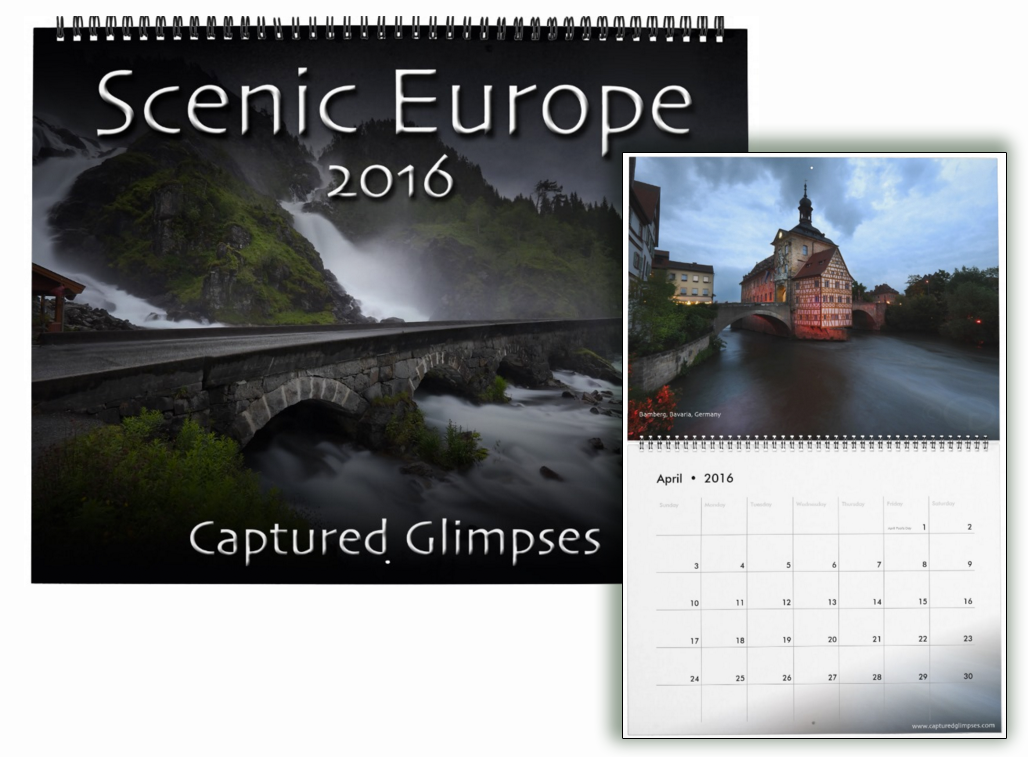
Buy the new 2016 Scenic Europe calendar here!

I've received a few requests over the last year to do a wall calendar.  Even though we all have online calendars and schedules on our phones, wall calendars still have some appeal.  Scrolling through the year on a phone doesn't have the same satisfaction as flipping the page over every month.  So, I'm happy to announce that my 2016 Scenic Europe calendar is now available!

You can find it on my new Zazzle shop.  The calendar is 14.25"x11" (36.2cm x 28cm) and spiral bound.  Each month features one of my most popular photographs from Austria, Belgium, The Czech Republic, Denmark, France, Germany, The Grand Duchy of Luxembourg, Hungary, or Norway.  So, for the price of three 11"x14" prints, you can have 12- and a nice way to stay organized in 2016!  And, there's another reason you may be interested in picking up a copy.  I will be donating a portion of my proceeds from each calendar sale to a very special program.

Even though we make our home in Germany, the U.S. is still where our hearts are.  While it may seem a little archaic, one of the ways we stay connected with home is through the radio.  There's an Armed Forces Network radio broadcast out of Wiesbaden and thankfully its broadcast area reaches all the way over to us.  Through it we stay up to date with what's going on at home in the States.  Also, and this is kind of difficult to explain, there's something really comforting about being able to hear the voices of people from the U.S.  We're very isolated where we live, completely immersed in rural Germany.  To be totally honest, there isn't a day that goes by that we aren't reminded of our status as outsiders.  This little radio station has brought a lot of comfort.  The AFN is, of course, a network for American Armed Forces bases, and the commercials and information relate to service members and their families.  So, these folks have been on my mind quite a bit.  I come from a family of veterans.  My grandfather served in the European theater of World War II, an uncle served in Korea, and my father fought in Vietnam.  Thankfully, they all came home without injuries or illness.  But, many service members are not blessed with that outcome.  Unfortunately, those that sacrifice everything for their country often receive the minimum help and the support they need when they are injured or seriously ill.  The sad reality is the federal government does not prioritize them.  Other organizations step in and try to fill the gap.  One of them is America's Fund.  It is one of the top rated veterans support non-profits out there and it provides help to members from every branch of the military.  This is the organization I've chosen to donate the calendar proceeds to.  I know people have varying opinions on the use of military force, foreign policy, and all that.  However, I don't think that the importance and value of service members and their families is up for debate.  No matter what our political views are, all Americans should all stand squarely behind these incredible people.

When you order you are given the option to choose the starting year (since this is labeled 2016, you'll probably want to leave that alone), the "culture" (which really means language), and the holiday listing.  Since these are sold from the U.S. store the only holiday options are for the States, so select "None" if you live somewhere else (unless you want to observe American holidays).  The calendar is available in Dutch, English, French, German, Japanese, Korean, Portuguese, Spanish, and Swedish.  In order to retain print quality I've only made the calendar available in the large size.

Back cover.
The calendar isn't the only thing available in my Zazzle shop.  I've been adding a variety of products every few days.  Right now there's a line of products featuring the Schiessentumpel waterfall (phone cases, pillow, stationary, puzzle) and many home and kitchen items with an an Autumn theme (napkins, cups, plates).  There is also another calendar available that is a small single page wall calendar featuring photographs from Germany.  I'm really excited about opening up this shop option.  I know it's difficult to commit to the traditional photographic medium of print and wall art (we only have so much wall space!).  But, with this option you can purchase functional items for your home or office that feature my photographs.  And, just to be clear, the donations to America's Fund will only be coming out of the 2016 Scenic Europe calendar proceeds.

So, head on over to my Zazzle shop and check it out.  I'd really appreciate it!

Thursday, October 22, 2015

Magic in the Mundane

In relation to last week's post, I'm still pondering a lot of subjects.  Besides what body to add to the kit before things amp again after the new year, I've been reflecting on the bigger picture (ha ha) of photography.  Why do we take pictures?  What is the purpose?  Why do I take pictures?  Why do I take the pictures that I do?  I've been doing a great deal of thinking, reading, and listening to podcasts.  Most of the time all that information and opinion overwhelms and sends my thoughts in a thousand different directions, but occasionally someone else writes or says something that turns the light on, the muddled thoughts drift away, and I get a sense of clarity.

The other day I listened to one of the We Shoot Fuji podcasts (#9) and it was one of those times that a light was shone into darkness.  That particular episode didn't talk so much about gear or technique, but covered exactly what I've been thinking about- what really matters in photography.  What I took away was that the goal is to capture a moment, to tell a story, and to document the world.  It's an excellent podcast episode and I highly recommend everyone listen to it even if they're just a casual shooter and no matter what they shoot with.  It kinda changed the way I see what I do.

When I first started seriously taking pictures with a real camera, I was shooting everything.  We had moved halfway around the world.  Everything, everything was different, new, and interesting.  As time passed, things weren't new and interesting anymore.  The people were just people, streets were streets, buildings were buildings.  Everything that was new had become normal.  So, I started focusing on scenes and subjects that still felt new and caught my eye.  That turned into scenic photography, and then filters and HDR blends.  While that was all well and good, and I love working those types of shots, I was neglecting the simple.  I got it in my head that I had to specialize.  I started only thinking about golden hour and blue hour and exposure times.  I was starting to lose the point.

Here's the thing, I don't have to specialize.  I don't work with clients.  I don't have to convince someone that I'm the best for the job.  It's me and the camera, not me and the camera and the person who hired me to take their picture.  I'm free from all of that, so why tie my own hands and mind? If I close doors on myself by just focusing on one type of shot, I'm preventing myself from experiencing why I started shooting in the first place.  Why did I?  To document as much as I could about this experience.  It's not just sunrises and sunsets and the early evening hours, its the whole day.  It's seeing everything as if it's for the first time again.  Not just wide, but tight.  Not just dramatic scapes, but the little things, the local character, the street scenes, the rainy days, and glorious days.  It's about capturing the truth.  Not just when we're on the road, but the days at home too.  It's not just pulling out the camera when we're visiting a new place, it's about seeing my town the same way.  It's about getting out there and using the camera and enjoying it, not about making it a job.

One of the photographers on the podcast compared it to portrait photography.  He said that even though those professional portraits of the family where everyone is looking their best are important and have value, the shots that really matter are the candids taken by you when everyone is relaxed and themselves.  They're not always perfectly lit and the subject's hair, outfit, or make-up may not be perfect either, but the moment is real.  What was going on in that photo actually happened, it was a authentic moment in time.  No one was out of shot posing the subject.  There weren't any reflectors bouncing the light just right.  It was true, a special instant worth capturing.  It tells a real story, not the story the subject wanted to be told.  He mentioned how when there is a house fire, people run to save their photos.  Those photos are even more special when they're of people who are no longer with us.  Which of those photographs are more meaningful, the professional portraits or the snapshots?  It's probably the snapshots, because those images show that person as they really were.

The same thing can be applied for other types of photography too.  In my case, the sweeping scenic shots are the professional portraits.  They are presenting a location at its best, when the light is just right.  A lot of work goes into those shots both during the moment and in post afterwards.  The other shots, the street shots and the tight shots, they're the ones that usually tell a story.  They're the ones that present the heart of a location, the ones that show a place for what it really is.  The scenic shots certainly have value.  They're eye candy, they say, "Hey, look at this beautiful place, don't ya wanna visit?"  When I see them after they're done I think of the process.  The other shots take the viewer a little deeper.  When I see them I remember the moment I took them.

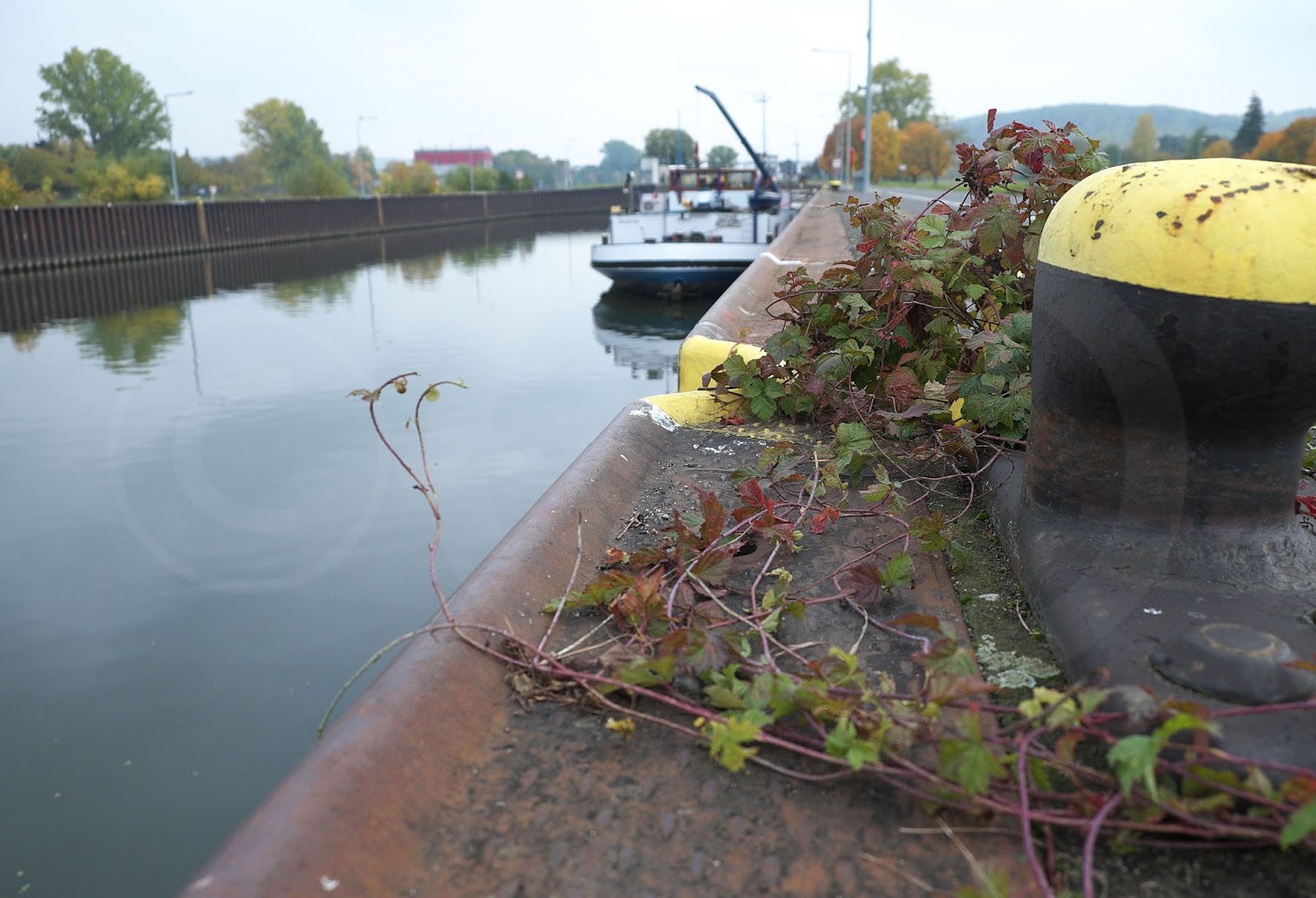
So, what does that mean?  I'm not going to stop shooting scapes and scenery.  However, I am not going to neglect the other shots anymore.  It's going to take some retraining, but I don't want to miss the whole experience like I have been lately.  That means I'm going to be shooting a lot more stuff, and I'm going to be presenting it here, on Instagram, and I'll start using my Flickr account again.  I'll be presenting more tight shots and more street (I'm not going to worry so much about that anti-candid movement in the EU as much as I used to).  As a part of this, I'm going to take my camera around town with me and document the place that's the biggest part of my life.  We're not going to be living here forever, and it would be a crime not to have many photographs of it.  Since we're not heading anywhere out of town until Thanksgiving, this is the perfect time to work on this project, which I'm entitling "Magic in the Mundane."  Here are a couple shots from this week that I took while walking The Dog along the Main River.  One of the river locks is in our town and it's a favorite spot for dog walking.  I took the X-E2 out with the 18-55mm lens and took a few wide shots of the lock and the river, but my eye was really caught by what was going on at ground level.  The bollards along the docking area at the lock aren't used very often and several of them have plant life growing around them.  Right now, the leaves are turning red and something about these delicate leaves wrapped around that bollard on a rusty metal plate and asphalt fascinated me.  You open the door to nature and it jumps in.

Camera: X-E2 Focal Length: 19.6 Ex: 1/1000, f/4.0, ISO 800
 River barges go by all day and when we first moved here, I loved watching them.  They're from all over Europe.  Each one has its own character, something that makes it unique.  Even though I've become quite accustomed to seeing them, I still stop what I'm doing sometimes to watch them go by.  Occasionally, one stops at the lock so the crew can make a supply run.  This doesn't happen very often since we're not a large town so I took the opportunity to take a photo.

Camera: X-E2 Focal length: 18mm Ex: 1/640, f/7.0, ISO 800
 This is one of the boats that went by today.  It moving pretty quickly and had one of those big old "chugga chugga" diesel engines.  I think it would be great to participate in a cruise on one of these barges; start out in someplace like Rotterdam and end at the Black Sea, passing through industrial cities, small towns like ours, and the incomparable European countryside along the way.

Camera: X-E2 Focal Length: 34.4mm Ex: 1/400, f/8, ISO 1250
This last shot is one of those that begs the whole story.  I don't know it.  I'd love to.  I see this man pretty regularly from the opposite side of the river.  About once a week, there he is, fishing with at least three or four feline companions.  I don't know if he passes a few of his catch over to his pals or if they're there to take care of the guts, but it's quite the scene.  Lots of people fish along the river, usually with a human friend, sometimes with a dog.  I'm pretty sure he's the only one that fishes with a clowder of cats!  I was originally out with the 18-55mm, but had to come back out with the 55-200mm for this one.  Thankfully, they were still there when I returned.

Camera: X-E2 Focal Length: 200mm Ex: 1/640, f/5, ISO 1250
These are the kinds of things I want to make sure I'm seeing and capturing again.  So, if you're interested in checking out some of these shots, follow on Instagram or check out my Flickr page (which I'll be updating over the next couple of days).  And, of course, there's always something new popping up on the website.  Check out the German Countryside gallery for the latest!