Thursday, October 15, 2015

Questions for Fall Days

It's been pretty quite around here lately.  The weather turned from summer to fall to winter in about six days and we've been scrambling to cope with the fast plummet into dark days and cold rain.  We don't have any travel dates lined up until November when we head back to Ohio for the annual visit home.  So, we've been hanging around locally and spending a lot of time cycling (trying to stave off the inevitable holiday chub as long as possible, ha ha).  Of course, this time of year is probably the most dramatic visually.  I've been taking the camera out as much as possible when we get a break from the seasonal monsoon.  We did a quick shoot on Sunday and I got out early one morning this week when there was some fog on the river.  The rest of the time it's been pretty wet or we've been out on the bikes.

Every weekend morning when we're home we're cycling.  We also hit the roads a couple of weekday evenings after my husband gets home from work.  We see a lot of incredible stuff on the roads and paths and, of course, the light is always at its best when the sun is just coming over or heading below the hills.  I don't take a camera with me on these rides, just my iPhone, and that's starting to bug me.  It's very difficult to balance the two things I love to do when they both need the same time of day.  The X-E2 is too big to carry in my jersey pockets, and I don't want to carry it strapped to my back (because a. that's not cool and b. it's pretty uncomfortable).  So, I've been using my iPhone.  Every time I pull it out of my pocket to get a shot of a great sunset, like the one below, I curse the absence of a real camera in my hand.  Sorry, Apple fans, they still don't make a phone camera that can stand up to a real camera.


It's raised the question of what my gear priority should be.  Like a lot of X-Series photographers, I'm waiting and waiting for the official specs on the X-Pro2.  In the meantime, I'm kicking around adding a compact to the collection- something small enough to slide into a jersey pocket, but better performing than the iPhone (which wouldn't take too much.)  I originally looked into a waterproof sports camera, but their capabilities aren't too much better than a smartphone.  Plus, they're designed mostly for underwater applications.  So, keeping in mind that a compact wouldn't be weatherproof, I started to check out some models with higher end glass and a few other features that I would like to have access to.  That's dumped me at the door of Sony and it's Cyber-shot RX100 III (yeah, I realize there's a IV but the older model is cheaper).  It's small, has a slick pop-up view finder, tiltable screen, multiple shooting modes, WiFi, and good optics from the Zeiss lens.  It's a tantalizing choice.  The price, though, isn't.  Knowing that I will be adding another X-Series body for my regular shooting sometime next Spring, the cost of an RX100 III would dip into the budget quite a bit.  But, I'm missing a lot of shots while out on the bike...

Decisions, decisions...

While I ponder this dilemma, I'll keep heading out on the paths with the X-E2 in between the deluges.  It has been absolutely stunning out there lately.


Thursday, October 1, 2015

Getting the Shot: The Crappy Truth


Last weekend we drove over to our old stomping grounds in the Grand Duchy of Luxembourg.  My Raleigh was in dire need of a drive train replacement and we decided that our old shop in Lux was the best place to do it for us.  My husband had a business trip there the previous Tuesday so he dropped the bike off and it was finished by the weekend.  We decided we might as well stay the weekend, meet up with some friends, and do a little hiking with The Dog.  One of the things we do miss about our old home is the hiking trails.  Luxembourg may be super small, but it does have some fabulous hiking.  The Mullerthal region is the premier hiking district in the country and there's a reason for that.  The Mullerthal is easily accessible from Belgium, Germany, and The Netherlands.  It's not the Alps or Scandinavia, but it's a good stand-in for a weekend getaway.  On the trail we met some Dutch, some Germans, some Belgians, and some French.  Clearly, the Mullerthal is the place to be.

I've done a lot of shooting on Luxembourg's trails, but not for about two years.  Also, the last time I was there I was shooting with my old DSLR set up.  I wanted another go with my Fuji, 3 Legged Thing, and the ND filters.  There was one spot in particular I really wanted to revisit.

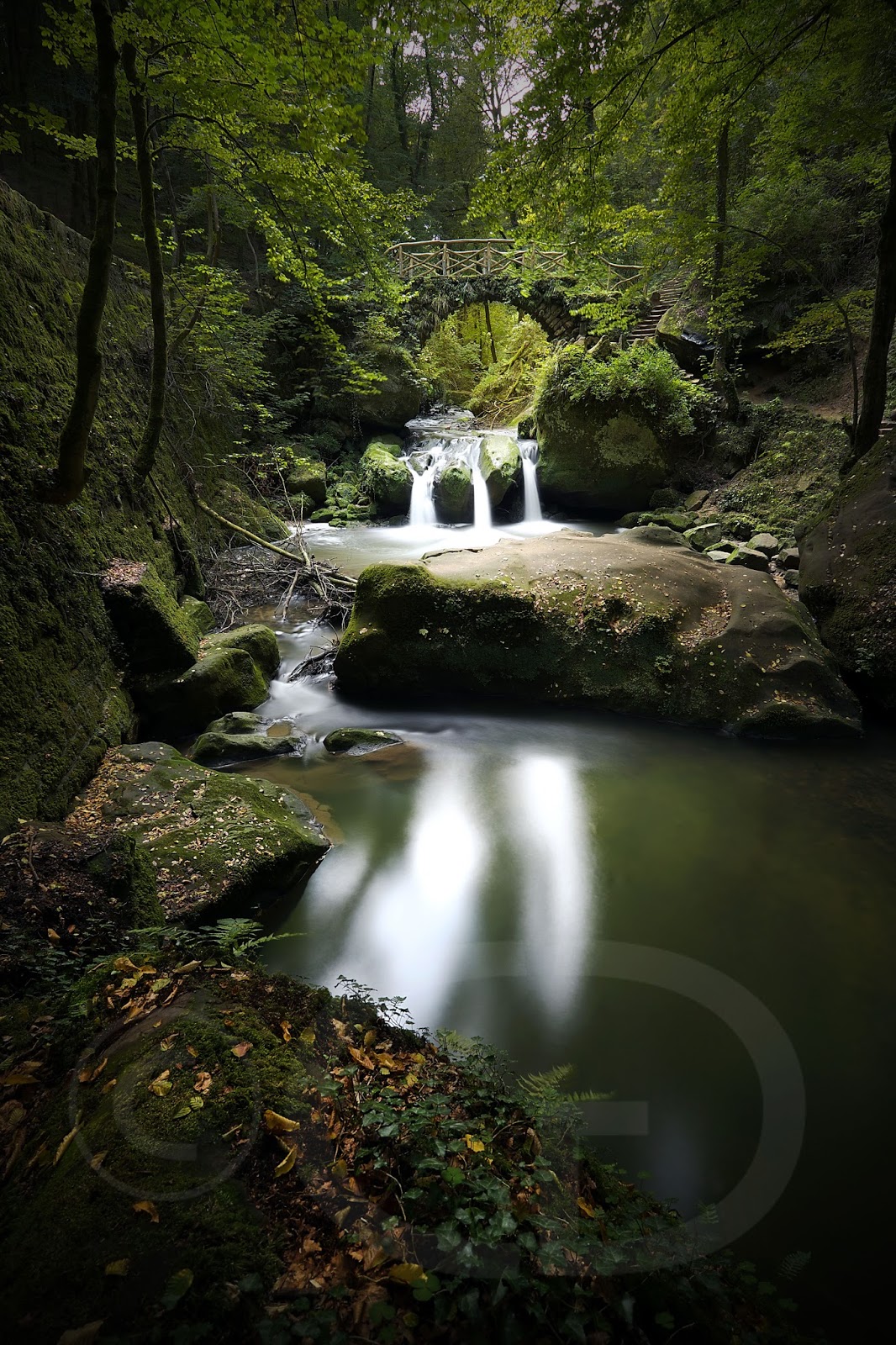
The Schiessentümpel waterfall is the Mullerthal's most well known sight.  It's not the most impressive waterfall in Europe, but it has a bit of a fairytale feel about it.  I shot it with a Canon Powershot the first year we were there and we hadn't been back.  This time I wanted to spend some more time and craft with the location to capture not only the waterfall, but also to be able to create a scene that conveys the magic of the place.  Little did I know that this was going to be one of the most difficult projects of the year.

I had a conversation a while back about the different types of challenges that photographers deal with depending on their focus.  The person I was talking with seemed to be of the opinion that those of us who focus on scenery have it a little bit easier than those who shoot portraits or special events because our subjects don't move.  Well, my opinion is that every type of photography has its unique challenges and none of them are easier or harder than another- except photojournalism and combat photography, of course.  That's at a whole different level.

When you see a photograph of some natural space, it often looks like a pristine, secluded, nearly untouched place.  I've learned while shooting places like this in Europe (with a high tourist population and lack of definable wilderness) that these images don't tell the truth about their locations.  There are a lot of uncontrollable variables to take into account, the most common and difficult to work around is the human factor.  Our eyes are especially attracted to the human form, which is way people find the Virgin Mary in their bagels.  Unless the goal is to capture a particular individual (like a model) in a place like this, usually the focal point of the photograph is an object in the scene (in this case it is the waterfall) or an entire vista. If there is a person in the shot it immediately distracts the eye.  I wanted the waterfall as my focal point, but I also wanted the eye to take in the entire scene.  A photobomb by a portly tourist in fluorescent pink would, in my opinion, completely ruin the shot.

We came to the falls around 2:30pm on Saturday.  Normally I would try to get to a location early in the morning or later in the evening, but our schedule wouldn't allow that.  Plus, it would be almost totally dark at those times in this location (a deep valley with heavy tree cover).  There were a handful of hikers and tourists milling around, but no more than I usually have to deal with.  However, the falls' proximity to the roadside meant that more people could show up at any time.  I wanted to shoot the waterfall from two vantage points, straight on from a distance and from a large rock directly in front of the falls.  With the amount of people around we were probably looking at about an hour shoot.  It ended up being close to two, and we returned the next day for a second round.  Of the two views I wanted, I ended up with only one acceptable exposure from one of them (on right).  To get this I climbed down the wall (visible on the left) to a large boulder.  This position got me to a place where other tourists couldn't access easily.  The focal length and the tree coverage meant I could probably paint any bombers out.  Thankfully, there was a break in the traffic long enough that I could get a clean 52 secs to take the shot.  Only one person stepped in towards the end of the exposure and painting them out wasn't a problem at all.  In this case, the most difficult part of this shot was the climb down to the vantage point.  But that was fun, so no complaint.  Next, after climbing back up the wall, we crossed the footbridge to get to the other spot I was after.  That's when it got really challenging.

The large rock is visible in the previous shot in front of the falls.  It's a really common vantage point for this location.  By the time we got over to the bridge three other photographers had lined up to do the shot from the rock.  One specific hurdle that scenic photographers have to deal with is each other.  In a spot like this there's always going to be people taking photos.  In this case there was only a few places to set up.  So, there we all stood, waiting for the first guy to take his shot, so the next guy could go.  The trouble was, the first guy was waiting for someone else to move- either to get in the shot or out of it.  Then, he wanted a shot with his friend in it.  Then they wanted to switch to repeat the whole process.  Meanwhile, of course, there were lots of other people moving in and out of the scene trying to get their photos and selfies.  I was the only one using a tripod, so I figured that I would wait because everyone else would, theoretically, be much faster.  It became clear that the other guys must be trying out new cameras because a lot of their time was spent messing with settings and not taking pictures.  Then, some other guy with a steadicam began walking back and forth across the bridge, down the steps near the falls, then back over the bridge to the wall above.  That would have been fine for me since he was moving enough to be blurred out in a long exposure, but he was wearing a bright pink hat that would create an unsightly blur across the entire scene.  Plus, no one else wanted this guy in their shot so all the other photographers were just sitting there on the rock not doing anything but taking up space.  I was positioned down below by the pool at the base of the falls waiting and waiting for everyone else to clear the boulder so I could climb up.  But they weren't.  The clock was ticking and we had an appointment to get to.  Even though it was a dinner, we still had to hike out another 3km to get back to our car and then drive 45 minutes to our hotel and clean up.  As I was standing there wondering what the heck was taking everyone so long, I discovered that I really liked the angle from the pool.  So, I set up my tripod quickly and began shooting.  When I was done, more people began showing up, filling the entire space and the other guys weren't making any sign of moving on.  I was really frustrated and out of time, but I thought I had something good.  We hiked out, passing a lot of stunning samples of trailside fungi and this really cool tunnel through the trees.


I had my waterfall shot from a distance and, I thought, an interesting angle from below the falls.  But, when we got back to the hotel and I uploaded everything to my iPad I discovered that, to my dismay, I didn't have a satisfactory exposure from the pool.  Every single one had a large blur on the left from the elbow of one of the other photographers.  The other guy thought he was out of my shot, but didn't realize I was shooting so wide.  I hadn't seen it on my view screen because of the darkness caused by the ND filter.  It was too large of a distortion to paint out.  I had one clean exposure, but to my complete disappointment the foreground was out of focus.  I was really bummed.  Really bummed.

I decided I wanted, needed to go back out there the next morning.  It meant another 45 minute drive out of our way before a lunch appointment on Sunday, but this time we would just drive up to the falls without hiking in.  We had breakfast at the hotel as soon as we could and ended up at the falls at 9:00am.  It was much darker than it was in the afternoon, but, mercifully, no one else was around.  I immediately set up down at the pool again and started shooting.  We were alone there about 10 minutes before other people started showing up.  I wanted to get a couple of exposures to blend and this took awhile.  Several times I had to stop mid-exposure because someone (always wearing a garish color) stepped into frame.  Because I had to raise the ISO level for the really dark location, I had to wait for the failed exposure to write to the card, which takes the same amount of time as the length of the exposure.  A minute exposure takes a minute to write.  It was definitely a lesson in patience. It took much longer than usual to get the shot, but I finally finished down at the pool and this is the end result of two days and a lot of waiting.

Multiple exposure blend
Then, I immediately moved up to the rock directly in front of the falls.  It took about a half of a minute to get my tripod in a stable position, but when I looked up the previous somewhat empty location was filled, positively filled with people.  Since I didn't even get one shot in before they showed up, there was no painting them out.


If I was shooting an album cover for the band "Dutch Tour Bus" this would have been perfect.  But, it wasn't what I was here for.  Several members of the group joined me on the rock.  The rest seemed to just be hanging out on the bridge.  It's a beautiful place and I certainly don't blame them for wanting to soak it all in.  One of the guys that joined me on the rock asked if I was waiting for something special to happen.  "Yep," I answered, "I'm waiting for this group to move."  He apologized and we laughed about it.  I stood on that rock for about 30 minutes.  I was certain that any minute the bus would head out, but they didn't and more and more people kept showing up.  It must have been a field trip day because these huge groups of people just kept appearing.  I realized that the chances of getting this angle were next to impossible.  I had missed my window.  Again.  When there was a break in the traffic on the rock, I tore down and left it.  We climbed up a short side trail as I reassessed the situation.  We had to get to lunch and once again the clock was ticking.  As we were standing there my husband noticed the view from our vantage point might make a good shot.  It's not the first time he found a good location.  I set up and then, once again, we were playing the waiting game as yet another group of people bombed the shot just as I hit the shutter button.  For some reason, everyone that morning seemed to be wearing pink, so there was no way they would blur out in a long exposure.  I had to wait for a break in the crowds.  One or two people in shot were workable, but a group of 20 couldn't be photoshopped.  "Dutch Tour Bus" had hit the road, but there still wasn't an ebb in the flow of people.  The distance this time meant I didn't need to use the filter, just lower the ISO, use a small aperture, and take a 1-2 second exposure.  On paper this should have been much easier to take, but the crowds of people were still preventing me from getting what I was after.  It was another 30 minutes or so before I had enough unpolluted exposures to create this final result.


The crowds had died a bit, but when I thought I could finally get the angle from the boulder a small group of people showed up and laid out a picnic lunch on it.  We had to get going.  The boulder shot wasn't going to be mine, but I was ok with that.  The shots I did have were ones I was pretty pleased with.

But, this year's most frustrating location had one more parting gift for us.  And, fittingly, it would be caused by humans.  On the way back to the car we headed down a rarely used path and I felt my boot squish into something.  It took a half a second to realize with total horror what I had walked through.  There was no mistaking the smell.  The feces stuck to the bottom of my boot weren't from a woodland creature or someone's dog.  It was from a person.  A person.  Stranger things have happened to me in Luxembourg, but nothing quite this disgusting.  And people back home think all we do is travel to glamorous locations and have fun.

While at first scenic photography may seem pretty straight forward or easy because you don't have anything to direct, the truth is that it is actually very challenging because you can't direct anything.  Besides weather, light, and other uncontrollable variables, hands down the most difficult thing to work around are other people and, sometimes, other photographers (or I should say other people with cameras). You either want the person in the shot or you don't in scenic photography.  Most of the time you don't because they are just too distracting in the scene.  A lot of really scenic places attract tourists, especially in Europe.  Tourists generally dress really brightly and their presence completely diffuses the ambiance of a location, whether in a city or the forest.  Most tourists (no matter where they come from) don't understand or respect a photographer's goals because they're too focused on what they want pictures of.  If you're set up with a tripod, you immediately become interesting.  Instead of moving along, a lot of people tend to stop and watch, completely clueless to the fact they are standing right in front of you, ruining the shot.  Others think it is ok for them to encroach on your space while you're shooting to see what you're doing or they think it must be the best place for them to take a picture from too.  I actually had a guy stand right over my shoulder with his face next to mine while I was in Hallstatt to see what I was looking at in my LCD screen.  Over the weekend when I was taking a macro shot of a mushroom, a woman came up behind me, leaned over me, put her smartphone next to my camera and took her picture- disrespecting my space and the fact her shadow totally blocked the light I was using.  Unless I'm going someplace remote or I time it before people are up and moving, the human factor is always going to come into play.  I totally understand why people are where they are and I don't begrudge their desire for their own photographs, but sometimes it can cause me a lot of problems.  I love creating calm and atmospheric images of places that convey that vibe while I'm there.  It isn't easy; it takes a lot of time and extra equipment.  A lot goes on behind the scenes.  Sometimes I have to climb down a retaining wall.  Sometimes I have to wait 30 minutes to get a 50 second exposure.  I really hope, though, that stepping in human waste is a one time thing.

Head over here to view these images in larger format and to purchase them in print or digital download.

Thursday, September 24, 2015

Science and Art

Camera: Fujifilm X-E2 Focal Length: 31.5 Exposure: f/3.6, 1/2,000, ISO 600
 My parents were visiting us for the last couple of weeks and we had a great time touring around southern Bavaria with them.  But, the beginning of the tour started in Austria, at one of our favorite places, Hallstatt, a spot we haven't been to since 2013.  Hallstatt is a small town perched on the side of a mountain and the Hallstätter See.  People have been living in this spot for about 7,000 years, mining the salt out of the mountain above.  They're still mining up there actually.  It was in Hallstatt that some of the first systematic archaeological excavations in history took place, back in 1846.  The finds there were so significant that they shed a bright light on prehistoric European culture.  That period of the archaeological record is now known as Hallstatt culture and it is the first recognizable period of Celtic civilization.

It was for these reasons that I wanted to visit Hallstatt back in 2013.  I wanted to see this famed archaeological site, its salt mines, and the material culture now on display in the town's museum.  It also had the attraction of being really easy on the eyes.  However, the visit in 2013 didn't go as planned.  A day or so before we were due to drive down there, I woke up with a nasty sinus infection.  I figured it was just a cold, and we headed down anyway.  Hallstatt was everything that I thought it would be.  It's the quintessential alpine village.  Timber buildings with wrap around balconies cling to the mountainside.  Narrow pathways take you up above the village for dramatic views (this way used to pass through attics).  There are two beautiful churches.  Flowers are everywhere.  Mountains tower above and the lake is calm and blue.  It's a pristine place.  In 2013, it was very wet.  It rained hard every day while we were there (pictures from that trip can be found here.)  I got sicker and sicker and woke up on the second day of the visit with a brutal ear infection.  I couldn't breathe, swallow, or hear out of one ear.  That led me to one of Hallstatt's lesser known attractions, the doctor's office.  Whatever I ended up having held on for a month.  But, all that aside, I still loved Hallstatt and it's now in my top three places to visit on the continent.  I always wanted to go back to Hallstatt without feeling like death, and, if we were lucky, with a bit more sunshine.  This second trip was a great improvement.

We spent about two days there.  Most of the time was spent in the village center where we had booked some rooms at the lovely Gasthof Zauner-Seewirt (they have an excellent restaurant, by the way).  Last time, except for a few breaks in the rain, I stuck mostly to tighter shots.  My photography goals for this visit were to capture broader landscape shots.  I had the equipment for it now, a solid tripod, ND filters, etc. and the weather was much more cooperative.  I decided to do all of this in the early mornings since the village faces east and the dinner hour this time of year overlaps sunset and evening blue hour.  Dawn shooting is our favorite anyway.  There's nothing like walking the streets of a place like this when the only other people up and moving around are the bakers.  There aren't any tourists with iPads and selfie sticks stepping in front of my tripod like there are in the evenings.  The atmospherics and light are very soft.  It's dead quiet.  Plus, we always get the freshest pastries and coffee when we're done.

But, it's not always a piece of cake.  Photography, as I've learned over the past few years, is all about, um, light.  Yeah, I know, duh.  But, it's more than the actual process of taking an image.  What the light is doing on the subject from one minute to the next can make the difference between ho-hum and wow.  It's also important where you are in relation to that light and the subject at any given time.  And, of course, it's kinda difficult to predict this sort of thing when you're working with weather and natural light.  No app is going to tell you exactly where and when the light is going to be perfect.  I've spent hours on cold mornings waiting for morning light that doesn't really show up.  Mountain locations are an extra challenge because the weather changes very quickly, very often.  The Alps aren't a studio location.  You can't set it up again if you missed the moment.  You have to wait until the next morning and hope that the sun shines in a cool way.  If it doesn't, oh well, get over it or come back and try again some other time.  Since I've started doing more land and city scapes, I've been trying to learn about more than correct exposure times, apertures, and Photoshop techniques.  I also spend a lot time studying things like weather patterns, light diffusion, and the rotation of the earth.  Photography really is a marriage between science and art, especially when it's being done in an uncontrolled location.  The challenge of getting the relationship just right is part of the fun.  I feel like I only succeed about an eighth of the time.  The really nice thing about a place like Hallstatt is that it's small.  Unlike Paris, where there are 1,001 places to shoot that are spread all over a huge space, old Hallstatt center is only 1 kilometer long.  Granted, there's a surprising amount packed into that space, but it is certainly easier to get around and get to know well.  There was good chance I could get a great shot or two with multiple mornings to work.

The main shot I wanted from this visit was a postcard style classic view of the village.  I had done it before, but I wanted a new version with sunlight, filters, and a tripod.  The first morning I decided to start on the north side of the village, looking down.  Then I would head over to the south side when the sun got higher.  It seemed like a promising morning.  The early colors were very brilliant.

Blend of three exposures.
When we headed uphill to shoot from above, the sun slowly came up and...meh.  I took about 30 or so exposures before heading south to the other side of the town to get this shot.  

Camera: Fujifilm X-E2 Focal Length: 35.8mm
Exposure: f/11, 8 secs, ISO 200
I really liked the effect of using the ND filter.  Hallstatt Lake is very deep and very smooth early in the morning, but by this time the boats had started running and the ducks were out chopping the water up.  The filter smoothed the water out again for me and created a touch of movement in the sky.  But, I had a sneaky feeling that I should have reversed my schedule.  So the next morning we started at this location before sunrise then headed up above for golden hour.

Camera: Fuljifilm X-E2 Focal Length: 10mm Exposure: f/11, 15 secs, ISO 200
That's more like it!  It turned out that when the sun came up over the mountains and shined on the town, it was hitting the north side just a little bit more dramatically than the south.  This morning there weren't any clouds so the shots I took below near the water ended up being kind of dull without that interesting color reflection that had been going on the previous morning.  But, when I moved up to the higher location- Bam!  They had been calling for rain overnight, but none in the morning.  I had hoped for some clouds, but ended up being pleasantly surprised with visible moisture in the air instead.  I loved the way it caught the rays of the sun as they shown down on the town.

The two mornings in Hallstatt were the best lesson I've had so far about the importance of science in photography.  Photo sharing sites are a huge help when I'm looking for locations when we're heading to a new place to shoot.  But, they aren't going to predict the right moment.  That's a matter of practice, study, and, sometimes, a whole lot of luck.

These shots and others are available for purchase in the shop under the Austrian Countryside gallery.

Thursday, August 27, 2015

End of Summer

XF 18-55mm f/2.8-4 LM OIS

As it's been a few weeks, I figured it was good time to check in.  After Norway, we've had several weeks off.  By off I mean we have been at home, not jumping on a train, on a plane, or in the car every weekend.  As awesome as traveling is, it is nice to have some down time living out of a dresser instead of a suitcase.  The cats are no longer confused about who their people are.  And, The Dog?  Well, I'm not sure if he's ever really pleased about anything, but at least he's getting regular hikes every week.

But, we haven't really been off with our feet up either.  Our evenings and weekends have been taken up with cycling.  We originally planned out that we would aim to do a 200km ride by the end of the summer.  We ended up biting off a little more than we could chew with the traveling this year and didn't allow enough training time.  So, we knocked it back to a 160km goal.  But, there was a sudden death in the family and I had to head back to Akron at the end of July.  Our training and fitness isn't where we wanted it to be when we laid down our goals at the beginning of the year, but it isn't a total wash.  This weekend we're going to attempt that 160km ride.  And, I'll be doing it on a new bike.  Upon returning home from Akron, I discovered my bottom bracket was starting to fail on my Raleigh.  It was actually easier to purchase a new bike instead of waiting for a shop to make the repairs (shops around here only repair by appointment and they have to be scheduled weeks in advance).  The new ride is a Fuji Roubaix 1.3LTD.  No, I didn't buy it because I'm obsessed with brands named after Mt. Fuji.  It was the only brand the shop stocked.  But, I'm really pleased with it.  It is another level up from the Raleigh, and, I gotta say, that upgrade makes quite a difference.  So, that's what's been going on.

As for photography, I've been going back to my roots a bit and have been shooting handheld when out and about.  The camera is always with me when we take The Dog on his hikes.  We've been hitting some local trails after our Sunday rides and I've kept my kit to the minimum, using just the 18-55mm or the 35mm.

XF 18-55mm f/2.8-4 LM OIS

XF 18-55mm f/2.8-4 LM OIS

The cycling regime definitely cuts into shooting time, however.  This hot summer meant the rides had to start early, right when the light was perfect.  While the X-E2 is pretty small, it's not small enough to fit in a cycling jersey.  One of the things I would like to add to my kit is a high end compact.  We pass by some incredible sights on our rides, and the iPhone camera is not doing them justice in the least.   I kinda hate opening up my portfolio from this time of year and only seeing flat iPhone exposures.  I'm really interested in the Sony Cyber-shot DSC RX100 range because they have features that no other compact has, but those price tags (and it always comes down to the price tags) are making an upcoming purchase unlikely.  The #1 gear purchase priority is still a second Fuijifilm X Series body.  Once they finally announce what the X-Pro2 is going to be packing I'll be making a decision on which camera to acquire next Spring (economy dependent, of course).  Losing shooting time and light for cycling is a frustrating situation, but I am compiling a great list of locations for later in the year.  Right now, after 4+ hours on the bike in high temperatures, the last thing I want to do is jump in the car and shoot somewhere.  On the weekends it takes a lot to stay awake past 8:00pm.

But, next week my parents are coming in for a visit and we'll be hitting the road to show them around Bavaria and the Alps.  It'll be the last major trip for 2015 before we head back to Akron for our home leave visit around Thanksgiving.  It'll be good to give the legs a bit of a break and get back behind the lens!

XF 18-55mm f/2.8-4 LM OIS

Friday, August 7, 2015

Trip of the Year

About fifteen years ago I stepped off a plane into Oslo Airport.  It was the first time I had left the United States (sorry, Niagara Falls, you don't count).  The next two weeks in Norway changed my life.  After that trip, I was addicted to traveling.  In the next three years, before I graduated high school, I visited 9 other countries.  My love of travel was probably one of the main reasons I chose archaeology as my field of study.  It's why I didn't freak out when my husband came home one day and announced The Company wanted to move us to Luxembourg.  That first trip abroad gets credit for a lot in my life.  Why?  There is no place on earth like Norway.  Ever since I left, I was obsessed with getting back.

Last month I did.

A trip to Norway takes some planning.  It's wild.  It's a little unpredictable.  It's expensive.  The thing is, though, it is totally worth it.  I say this with complete sincerity, Norway must to be on your bucket list.  It must.

We had nine days and the goal was to get a full sampling of Norway's widest section.  Norway is one of the few countries in Europe where wild camping is permitted, meaning you pitch a tent pretty much wherever you want.  As much as we've been craving a proper backpacking trip that doesn't involve campgrounds, friteries, and Dutch RVs, we wanted to spend some time there first to get a feel for the terrain, the weather, and the people.  We didn't want our only visit to be spent entirely in the backcountry without getting to know the place a little bit. So, we rented a VW Golf and did a road trip circuit which started and ended in Oslo with pauses in Fossbergom, Bergen, Odda, Valle, and Kristiansand.

We didn't linger in Oslo on the first day.  We immediately hit the road, passing by Lillehammer, and began following the Otta River towards the mountains.  It didn't take long before we realized that this was, hands down, going to be our favorite trip of the year.

In Fossbergom
Head here to purchase 
The Lom Stave Church
Head here to purchase
The first day ended in Fossbergom, home to the magnificent Lom Stave Church, the start of the Fylkesvei 55, and our second favorite restaurant in Europe (the Fossheim Turisthotell restaurant).  With the smell of the old tarred wooden church, the sound of the waterfall, the relaxed friendliness of the locals, and the warm ambiance of a 120 year old hotel, all the emotions from being in Norway the first time came flooding back.

I'm not going to go into a point by point description of our trip, I'll just pass along some of the highlights.  From Fossbergom we drove Rt. 55 over the Jotunheimen Mountains down into fjord country.
The most beautiful and longest roadway tunnel on earth
Head here to view or buy
Then it was on to Bergen, my favorite Norwegian city.  We spent an entire day above Bergen hiking the route from Mt. Ulriken to Fløyen, which was the most painful, challenging, and humbling hike of my life.  Dinner that night was in the old Bergen Fish Market, and, let me tell you, canned beer and fish & chips never tasted so good.

Bergen Harbor
Head here to view or buy
Mountain trail.
Head here to view or buy
From Bergen we headed back to the mountains (because we're obsessed) towards the old industrial city of Odda.  This is when we also turned away from the tourist area of Norway.  Odda ended up being the most surprising place we visited.  Despite its prime location at the southern end of Sørfjorden and its proximity to one of Norway's most famous natural wonders, the Trolltunga, Odda looks and feels like it was transplanted from West Virginia mining country.  The paint is peeling, the shops are all abandoned, the locals don't seem to have any zest for life, and the only place to eat in town is a disturbingly raucous and sticky buffet/carry out place.  It was fascinating to find a spot untouched by Norway's recent oil prosperity.  It was like stepping back in time, a time that I'm sure the country isn't keen on returning to.  That night, while I slowly digested the rubbery pizza from the town's one restaurant, I watched the light fade over the fjord.  Netflix's Lillehammer fittingly flickered on TV (with the English subtitles unfortunately missing).  It was well past midnight and the sky was still quite bright.  I laughed, remembering how this troubled my friends and I on that first trip.  We had all felt a little zombie like thanks to restless nights caused by the excitement and the midnight sun.

Midnight in Odda
Head here to view or buy
Then it was south towards Valle.  There were more mountain passes, tunnels, ferries, and waterfalls.  Oh, the waterfalls!  I was constantly asking my husband to pull the car over all week so I could shoot the mirror clear fjords and the graceful falls.  But, while it was the hardest place to shoot, the Låtefossen blew all the other falls away.

Låtefossen
Head here to view or buy
I mean, look at that place!  I have a lot of favorite shots from this trip, but I think this one takes the prize of number one.  Norway is absolutely dripping with waterfalls.  But, as you can see, this one is massive and pours out below the road.  You end up right under the thing.  This made shooting rather challenging because of all the water.  Norway had a pretty wet month, so the falls were roaring.  The narrow spots other photographers have used to get down to the river were completely submerged.  One false move would have you in the midst of the tumult, never to surface again.  And, of course, the mist coming off the falls covered the lens pretty quick.  I only had a short period of time to get the exposures I wanted before I'd have to wipe it down.  Thankfully, I've been practicing with my ND filters quite a bit and was able to get the exposures on the first attempt.  Also, mercifully, no one stepped in my frame.  I'm satisfied with how this turned out, but it taught me that if I want to shoot in conditions like this regularly I should definitely invest in a weather-sealed system!

Fjord Ferry
Head here to view or buy
Our drive south ended in the shipping city of Kristiansand.  After a day spent in the tiny hamlet of Valle, where dinner was a gas station burger and the most exciting thing to do was watch people park their RVs, the relatively small city of Kristiansand felt like a bustling metropolis.  We had also left the mountains and fjords far behind and the flat expanse of the harbor prickling with masts felt oddly disquieting.

Kristiansand
Head here to view or buy
Then it was on to Oslo and the final days.  I could honestly could have skipped Oslo all together.  Its current revitalization/destruction projects make it more difficult to navigate by car than Rome and it has taken on a steady undercurrent of social unrest, like many European cities.  But, it is home to some of the best museums I've ever been to and archaeologists go to a lot of museums.  Of course, the Viking Ship Museum is a bit archaic in its presentation, but the ships themselves are unmissable.  However it is the Folk Museum and the Fram Museum that make the museum district worth a day in Oslo.  Norway is dotted in old farms,with big red barns, and turf roofed outbuildings.  The Folk Museum gives you the chance to step inside them.  You can see what it like to live on a modern farm or a 15th century one, and anything in between.  For me, this was a fabulous photography experience.  Instead of sweeping landscapes, I was getting the chance to capture the details of rural Norwegian life from the present and past.

15th Century cowshed loft
Head here to view or buy
 So, Norway?  I'm still coming down from that trip.  I was concerned that the imagination of my youth would create unrealistic expectations, but Scandinavia's most beautiful country (at least in my opinion) didn't disappoint.  It has changed some in 15 years, yes.  There's more development in the countryside.  It is definitely more expensive.  But, it still stops me in my tracks.  The fjords, the falls, the jumbles of rocks thrown from some unknown height, the endless tunnels, the relaxed and personable locals, the food, the leisurely speed limits, the lifeless peaks, and the lush valleys, every single bit of Norway seized me yet again.  Guys, I'm totally and hopelessly in love.  I fell hard in high school I don't think I'm ever going to shake the place.  It's in me.  It's way more fun exploring with a Golf and my husband than it was on a bus with a bunch of high school students and teachers.  I think we got a great sense of the country on this trip, and we're hoping we can go again sometime with some backpacks and a tent.  So, yeah, I'm still obsessed with getting back.


Unsurprisingly, I have a ton of shots from Norway.  You can see my countryside shots in the Norwegian Countryside gallery and a handful of city shots in the Norwegian Cities gallery.  I'll be revisiting some of these photos in later posts.  There's a ton to write about from the drive on Rt. 55 and that day on Mt. Ulriken deserves its own post.

Friday, July 3, 2015

TAHERA Part III: Vienna

Burgtheater
We have finally come to the final part of The Austro-Hungarian Empire Rail Adventure.  Having miraculously escaped Slovakia, we arrived at Wien Hauptbahnhof on schedule, hopped on the metro, and checked into our hotel where we would be staying for two nights.  The sun sets earlier in this region than at home in Germany, so we were out the door shortly after dropping off our bag.  Dinner arrangements hadn't been made since our schedule was open that day, but the large lunch in Bratislava held us over for the rest of the day.  We spent our first night wandering from building to building shooting the incredible Viennese architecture.  Let me tell you, if you're an architectural photographer, Vienna is your playground.

Austrian Parliament
Speaking of architecture, this is a good time to bring up a rather disconcerting turn of events here in Europe.  As I've written about in the past, candid street photography (in which a private citizen can be recognized) is technically illegal in most European nations.  It's completely acceptable to take the photos, unless the subject sees you do it and objects.  However, it is illegal to display the photos in a public forum, meaning the internet or a location open to the public.  More and more cases are being brought to court against street photographers and fewer people are pursuing the art in Europe because of it.  In my opinion, this is a huge problem not only for photographers (professional or amateur), but also for the public.  Without photographic documentation of the world as it is, we are at a huge risk of losing cultural heritage and identity.  If these laws stay in place, candid photos in Europe may be completely lost to future generations.  Candid travel photos are at risk as well.  All that will be left are scenic photos or, worse, wedding photos.  What if this had always been the case and we didn't have the likes of Maier or Cartier-Bresson?

Well, architectural photography is at risk of becoming regulated in Europe as well.  If the current change to copyright legislation is passed in the European Parliament, buildings designed by living architects will no longer be allowed to be photographed without prior approval of the architect.  As it is now, some buildings fall under various copyrights in Europe already.  For example, posting or publishing a photo of the Eiffel Tower at night is technically illegal because the lighting design is trademarked.  It is ok to photograph the tower during the day and sell the photograph, but you can't legally sell one of it lit up at night.  Other landmark buildings can also be trademarked to prevent professionals from photographing them, but private citizens can still snap away.  It is one of those frustrating things photographers in Europe have to deal with.  Before this trip, I had to do research into photography laws for each country and plan accordingly.  This proposed law is even worse.  Not only will it regulate professional photos of modern buildings, it will regulate private photos as well.  Take a selfie in front of the London Eye?  Well, you can forget posting it to Facebook if these lawmakers get their way.  Once again, I find this absolutely ridiculous.  Photography should not be regulated to the degrees it already is in Europe, restricting it further is a crime.  Please, please, please, sign the petition at Change.org and if you are a European citizen take the time to contact your MEP.  Folks in the USA, you think this doesn't matter for you?  You're wrong.  If you ever take a trip to Europe, your photos are at risk of being regulated.  Also, these sorts of laws are springing up at home too.  Arkansas, I'm pointing at you!  Ok, I'm sorry for the aside.  This is a really sore subject and one that I believe is more important than most people think.

Anyway, back to Vienna.  Since we had two days in the city we decided to do more of the sightseeing things than we did in the past two stops.  The whole region was experiencing an incredible heatwave, but Vienna was the hottest.  The highs for both days were in the upper 90's Fahrenheit.  In order to beat the heat a little and dip our toes into Imperial history, we opted to visit a few indoor attractions- the colder the better.  Our first stop was the Imperial Crypt, or Kaisergruft, where a good portion of the Habsburgs rest in peace.  If you're really into Austro Imperial history, this is a must see.  We're not, but it was still a fascinating place to descend into since the coffins and sarcophagi are fascinating works of art.  It isn't a huge tourist attraction, so we were able to take our time and I took many shots of the interior and its contents.


From there, another cold subterranean location sounded nice so we headed to St. Michael's church.  At 11:00 and 13:00 they have guided tours of the church crypt.  The attraction for the crypt tour borders on macabre, but for the archaeologist in me it couldn't be passed up.  The crypt doesn't house the remains of anyone particularly famous (unless you're a baroque opera fan), but the condition of several of the remains is quite remarkable.  Down below St. Michael's you can view mummies from the 17th and 18th centuries, up close, in all their moth-eaten finery.  It's also quite cool down there, so well worth the visit for the overheated, but non-squeamish.  We were really impressed with the tour.  Usually, these types of attractions only permit visits with a guide who will only speak in the native language or give the briefest of brief synopsizes in English.  Not so with this tour.  It would have been a huge letdown to miss all the information provided by our guide, but he graciously gave each spiel in its entirety in both German and English, even though my husband and I were the only non-German speakers on the tour.  The guide not only gave us the history of the crypt, but also of the church, the area, and burial practices of the time.  We were also able to examine the mummies very closely.  It was a well spent, fascinating hour, which I heartily recommend.  Photos are not permitted, so you'll just have to use your imagination.

From there we headed to another cool location, the Imperial treasury located in the Hofburg Palace, the city residence of the Habsburgs.  This building is the main tourist hub of the city and houses several museums and the famous Lippizaner stallions that everyone makes a big deal of.

Interior dome of the Hofburg Michaelplatz Gate

Michaelplatz entrance of the Hofburg

Detail of the Master of the Sea fountain on the Hofburg 
This area is also the place to hire your carriage tour

I adored the expressive sculptures on the Hofburg.  This is detail from the Master of
the Land fountain.  The palace is also adorned with sculptures of the trials of Hercules
The stallions weren't performing during our visit, so we kept our tour to the treasury.  After spending the morning amongst the dead of Vienna, the gems and finery they couldn't take with them provided us with a stark reminder that wealth, in the end, is meaningless.  The people buried in the Imperial crypt are just as rotten as the ones we saw beneath St. Michaels.  All the things they acquired in their lives sit behind glass, unable to spare their previous owners from mortality.

As the sun began to sink a little in the sky it was time to head to the one thing we scheduled ahead of time, a live performance of Mozart.  Mozart's Requiem is one of my absolute favorite compositions.  Introitus, is probably my absolute favorite piece of all.  I couldn't pass up a chance to hear it live in Vienna, and there just happens to be a performance every Saturday evening in the summer at Karlskirche.

Karlskirche and its reflecting pool at blue hour, after the concert.
Detail of Karlskirche
Karlskirche is a masterpiece of baroque architecture, and one of the most popular spots in the city to photograph because of the reflecting pool.  The concert itself was not nearly as moving as I expected (alas for expectations unmet), a fact I blame on poor acoustics caused by a ton of renovation scaffolding in the dome.  However, spending time afterwards shooting the church made up for it.  It was probably the most satisfying location in the city, albeit a bit difficult to maneuver because of the crowds.  From there, we headed off to find dinner and then grab a coffee and a famous Sacher-Torte.

We picked up on something during our hunts for food and beverage in Vienna.  It is perhaps the most non-service minded city in western Europe.  We have all heard the stereotypes about Parisians and the its rude servers.  However, I can without a doubt in my mind, say that this is not true of the City of Lights.  At no time in all our travels in Paris have we encountered a rude restauranteur, server, or shopkeeper.  We have dined in fine restaurants, cafes, and everywhere in between and the staff have always been just as friendly as ones found anywhere else.  If a mistake was made (which is rare), they always rectify it with plenty of apologies.  If you want to have an unpleasant dining experience worthy of the Paris rumors, go to Vienna.  You will not be disappointed.  First of all, there is a weird law in Vienna that all outdoor seating areas have to be closed at 22:00.  So, if you arrive an hour before that time, you will be rushed, even if you're just having drinks.  One restaurant manager made quite the embarrassing scene when we arrived for dinner around 20:30, making a huge deal about how important it was that we hurry before the patio closed.  When we asked our waiter if we would be permitted to move indoors, the manager returned to make another fuss in which he asked us if we were accusing him of lying about the closing time.  We weren't the only ones to be made fools of by the staff.  It seemed everyone around us was having just as miserable of a time. Then, they spaced out our dinners a full half hour from each other.  I was finishing up my incredibly tough and unpleasant roast beef when my husband finally received his food, with no apologies from the staff.  Instead they pointed fingers at each other for the fault.  The waiter then had the audacity to request a tip at the end of the meal.  It is my firm belief that this was the worst dining experience we've ever had on the entire continent.  From there, thinking that must have been a fluke, we went to the Sacher Cafe for the famous coffee and torte.  Guys, the coffee comes out of the same machine that most European hotels have in their breakfast rooms.  The torte is the most overrated thing I've ever eaten.  It tasted like jam.  The chocolate cake was completely flavorless.  I wish I could say that evening was a weird one, but not matter where we went the service was inattentive.  We practically had to jump up and down to be waited on at cafes and the servers all had this attitude that we were inconveniencing them.  Dining in Vienna was surreal.  We've been traveling all over the continent for 3.5 years now and have become pretty used to the idiosyncrasies of the European service industry, but we have never experienced that level of rudeness anywhere.  We did have one nice meal, a lunch at Chamäleon.  The food was pretty good and, for once, the staff was attentive and respectful.  So, my recommendation?  Eat at your own risk in Vienna.  This might be the only place I recommend avoiding the local cuisine if possible.  Heck, the goulash is better in Hungary, the beef is better in Czech Republic or Slovakia, and you can get Wiener Schnitzel anywhere.

A scene from the one place we ate at in Vienna that wasn't dreadful
On Sunday, we took the metro out to the Schloss Schönbrunn, Austria's Versailles.  This is a location where unauthorized professional photography (and to the staff that means a tripod) is not permitted anywhere, even in the gardens.  No photography is permitted inside the palace at all.  So, we left the tripod in a locker at the train station and I shot a little bit on the grounds by hand.


You have to book your tour time online if you want to be guaranteed a visit to the interior, it is so popular.  We booked an afternoon slot, hoping to miss the tour bus crowd, and walked in what shade we could find in the gardens.  It was the hottest day of the trip so far and we were positively melting.  Climbing up to the Gloriette monument in the blazing sun was out of the question, so we dipped into the cafe near the palace zoo (the oldest in Europe) and waved and jumped around for a bit before we could order some drinks before our tour.  On a less hellish day, I would have enjoyed further grounds exploration and shooting, but with the temperatures near 100, the only thing that sounded manageable was a beverage in the shade.  Our tour of the interior was interesting, but very crowded, thanks to the holiday weekend.  We were happy to jump back on the metro back to the city for an afternoon in the park before catching the night train back to Frankfurt.

Volksgarten
National Library
However, despite its disappointing dining offerings and tourist crowds, Vienna is worth a visit.  It's definitely snooty and snobbish, far beyond Parisian standards, but it is a beautiful city to look at.  The sights are top notch and majority of the city looks like it is constructed of wedding cakes.  The photographic opportunities are endless.  I would go back to shoot more if given the opportunity, I'd just eat at Chinese or döner places instead.

Being Sunday evening, we headed to the station early since nothing else was open to do.  Wein Hauptbahnhof is the newest station in Europe, having just opened in October 2014.  The construction which continues in the area is incredible.  It is certainly the nicest station we've ever been in.  There is plenty of clean restrooms, lockers, and a wide variety of dining options for travelers.  We enjoyed people watching for a while from a comfortable waiting area and had another interesting chat with a fellow traveller.  This time we met a Romanian man who enlightened us on how itinerant workers like himself get around Europe.  At first we were concerned that he was a panhandler who just wanted to hit us up for money, but instead he just wanted to talk.  He said he had a pack of cigarettes and a can of soda and that was all he needed to be happy.  He told us how he travels by train without a ticket (baksheesh), what countries he can visit without a passport, and how he makes money on his travels when he can't find work.  That man has donated a lot of blood!  It was a fascinating conversation, and a part of the trip that will always stick clearly in my mind.  You never know who you will meet while on a train or waiting for one.

For once our train arrived on time, but it would be over an hour before we left the station (we would arrive 3 hours late in Frankfurt the next morning).  It was no matter to us.  We were able to purchase carryout at the station, so no need for microwaved hotdogs that evening.  We were once again in a private sleeping compartment and were quite comfortable for the remainder of our journey.  We ate our dinner sitting on the lower bunk and watched the rail workers outside the window while we waited to pull out.  With a rather early arrival expected in Frankfurt we turned in early.  I finished out the evening reading a chapter from The Great Railway Bazaar, fitting reading for the trip.

All in all, I think TAHERA will go down in the books as one of the most memorable trips we had in Europe.  It certainly wasn't smooth sailing nor did our destinations meet our expectations all the time, but it was a unique and fascinating way to see that part of Europe.  There are things we would do differently for sure.  We'd try to allow an hour between trains in Germany since DB is chronically behind schedule.  We would have preferred more time in Budapest, and would bypass Bratislava completely.  We'd skip the Viennese cuisine.  I'd shoot such a trip very differently too.  In hindsight, I wish I'd shot the trains and travel experience.  Because of our constant state of being rushed and overheated, photography was the furthest thing from my mind, but it would be nice to have captured the experience for posterity.  I tend to avoid shooting in train stations since they are high crime areas, but not having anything from a huge aspect of our trip is something I regret.  If we did another train tour, I'd shoot more of a documentary style and not focus as much on scenery as I normally do.  I'd bring with one prime to save space and weight, especially if the weather was the same.  One thing we definitely don't regret is booking the sleeping berths.  That saved a lot of time and effort.  It was nice to be traveling while sleeping, with a cup of coffee hot and waiting in the morning.  I'd never travel overnight in a regular seat again as we did to Prague, but I wouldn't hesitate if there were private compartments available.  On that trip it was more comfortable than the hotels because the trains are air conditioned. A train tour in Europe is something I've always had a hankering to do and I'm incredibly grateful we had the opportunity.  With the knowledge we've gained through the experience, I'd happily plan another rail adventure.

Photos from TAHERA can be purchased at capturedglimpses.com from the Budapest, Bratislava, and Vienna galleries!